Lincoln University of Missouri Leads State in Enrollment Growth for Second Consecutive Year
Office of Communications and Marketing
Young Hall
820 Chestnut Street
Jefferson City, MO 65101
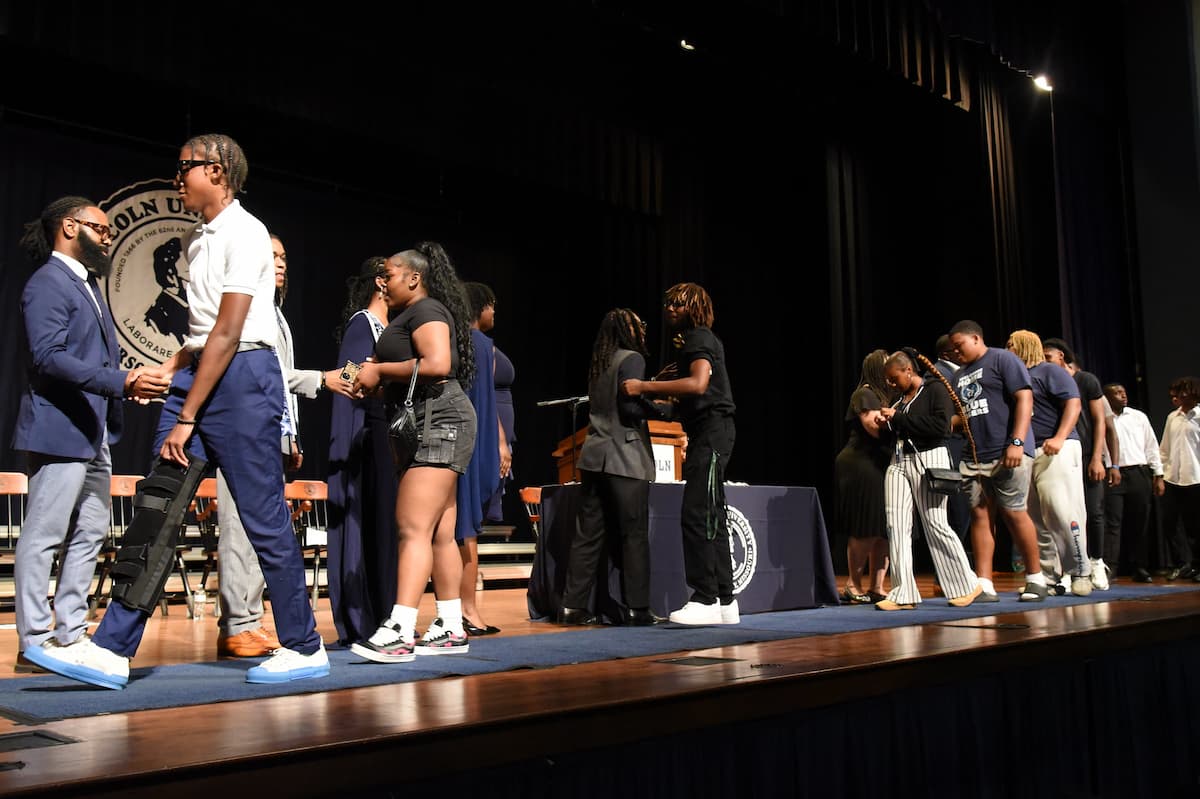 Students are welcomed at Lincoln University of Missouri’s 2025 New Student Convocation. For the second year in a row, Lincoln leads all public, four-year institutions in Missouri in enrollment growth.
Lincoln University of Missouri is leading all public four-year institutions in Missouri in percentage enrollment growth for the second consecutive year, according to fall 2025 data released by the Missouri Department of Higher Education and Workforce Development (DHEWD).
According to the data, Lincoln University recorded the largest percentage increase in both total headcount enrollment (9.8%) and full-time enrollment (11.5%) among Missouri’s four-year colleges and universities. This marks the second consecutive year Lincoln has led the state in both categories.
Beyond year-over-year gains, Lincoln University also posted the largest three-year change in both total headcount and full-time enrollment, as well as the largest five-year increase in full-time equivalent (FTE) enrollment among all four-year institutions, underscoring sustained, long-term momentum.
University leaders note that this growth is not only about attracting students, but also about supporting them once they arrive. Lincoln University achieved its two highest first-year retention rates in more than 30 years, with a rate of 61% in 2024 and 64.4% in 2025, reinforcing the university’s focus on persistence and student success.
“Lincoln University was founded to expand access, opportunity and upward mobility, and that mission continues to resonate with today’s students,” said Lincoln University President John B. Moseley. “Across the country, students are thinking more carefully about where — and how — they pursue higher education. Our enrollment data suggest that students are responding to institutions that provide clear pathways, strong support and an environment where they can succeed.”
Retention initiatives have played a key role in sustaining enrollment momentum. Key partnerships, such as the Connect Blue Program with State Fair Community College, have enabled seamless enrollment for transfer students. In addition, Lincoln has invested in targeted student success programs to support students at critical transition points. The Summer Bridge Program, for example, helps incoming first-year students build academic confidence, strengthen study skills and establish early connections to campus resources before the fall semester begins. Programs like Summer Bridge reflect a broader institutional commitment to long-term student achievement.
That focus on persistence is also reflected in measurable academic gains. Comparing the end of the 2023–24 academic year to the end of 2024–25, first-time freshmen saw significant academic improvement, with average GPA increasing by 5%, an indicator of stronger academic preparation, engagement and support during students’ first year.
University leaders emphasize that the enrollment increase reflects broad-based momentum. Black undergraduate enrollment increased by 90 students, a 31 percent year-over-year rise from fall 2024 to fall 2025, growing from 292 to 382 students. Additional enrollment increases were seen among dual-credit students, visiting students and other nontraditional populations, suggesting that students from a wide range of backgrounds and life stages are choosing Lincoln University for academic, professional and workforce-aligned pathways.
Athletic success has further contributed to a sense of confidence and momentum across campus. The men’s basketball team advanced to the NCAA Tournament for the first time since the early 1980s. Women’s track captured the GLVC Championship in the program’s first year in the conference. Men’s soccer advanced to the NCAA Tournament for the first time, and Lincoln University hosted an NCAA Tournament competition for the first time in school history.
Looking ahead, enrollment gains are coinciding with major investments in campus infrastructure designed to support student life, research and long-term growth. The fully funded $45.5 million Health & Security Sciences Institute construction is scheduled for completion in summer 2026. In fall 2025, the university completed a $23.5 million, fully funded renovation of its largest residence hall, along with additional campus renovation projects. Plans are underway to break ground on a new $10 million meat-processing research facility, which is also fully funded.
“As a public HBCU with a long-standing mission of access and opportunity, Lincoln University continues to adapt to meet students where they are,” Moseley said. “Our recent enrollment trends underscore the importance of pairing access with support and building pathways that help students persist, achieve and succeed well into the future.”