
LU Cooperative Extension Highlights Native Edible Crops and Agroforestry
Office of Communications and Marketing
Young Hall
820 Chestnut Street
Jefferson City, MO 65101
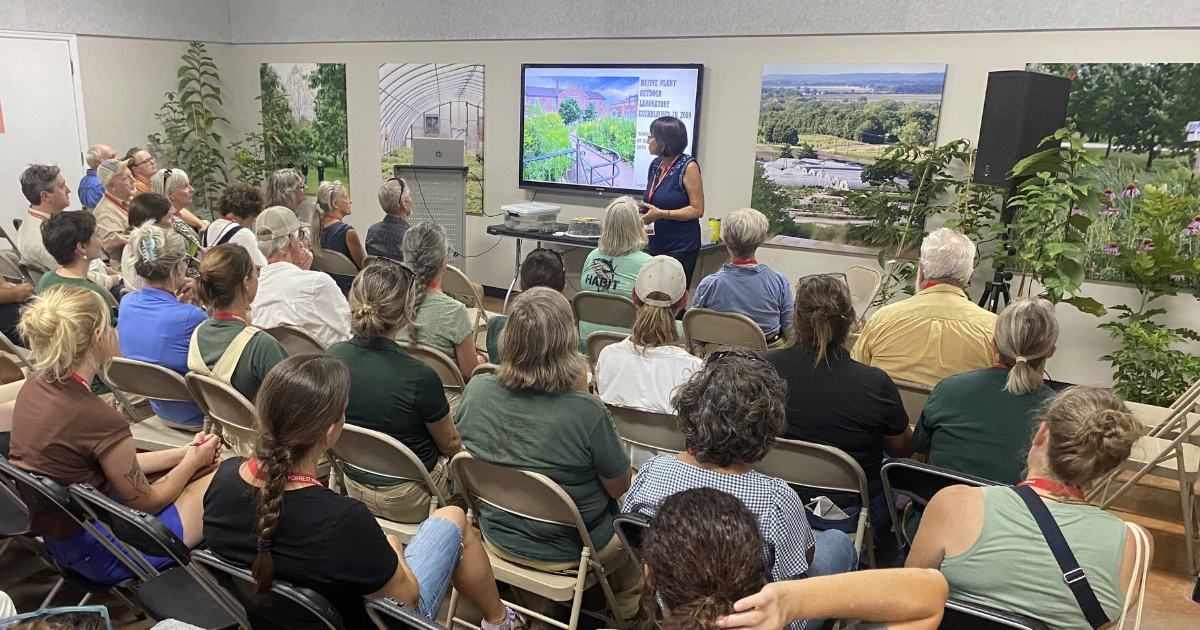 Nadia Navarrete-Tindall speaks to attendees during Forrest Keeling Nursery’s annual field day in Elsberry, Missouri.
Lincoln University of Missouri’s (LU) Nadia Navarrete-Tindall, Ph.D., joined more than 500 growers, landowners and native plant enthusiasts at Forrest Keeling Nursery’s annual field day in Elsberry, Missouri. The nursery specializes in native trees and other native plants used for conservation, agroforestry and landscaping.
“I was invited as one of the guest speakers to talk about what we do at Lincoln with native edible trees and other native edible plants,” said Navarrete-Tindall, a state Extension specialist who leads the university’s Native and Specialty Crops Program.
Through her work with LU Cooperative Extension, Navarrete-Tindall travels across Missouri sharing information about native plants as specialty crops, including how to grow and market them and the role they play in healthy ecosystems.
“People are really interested in learning about native plants,” Navarrete-Tindall said. “They produce food for us while also supporting pollinators and other wildlife.”
During her presentation, she highlighted several native edible crops grown and promoted through LU’s Native and Specialty Crops Program, including pawpaws, persimmons, wild plums, elderberries and native nut trees such as bur oak and hazelnut. She also discussed their potential as specialty crops for Missouri producers.
“Forrest Keeling Nursery wants people to see how others are growing these plants, what they can do with them, how to grow and maintain them and which ones may be profitable for producers,” Navarrete-Tindall said.
Kim Lovelace, one of the owners of Forrest Keeling Nursery, connected Navarrete-Tindall’s presentation to the nursery’s broader interest in native crops.
“You helped us see native fruit and nut crops as both ecological contributors and viable opportunities for Midwest farms,” Lovelace said.
Attendees saw pawpaws and persimmons growing at the nursery and learned about Forrest Keeling’s Root Production Method, or RPM, which encourages strong root systems before transplanting.
Navarrete-Tindall also discussed agroforestry and companion planting, including ways producers can grow native trees alongside other crops. Companion planting pairs plants that can benefit one another when grown together, helping producers diversify what they grow while making better use of the same land.
Her focus on native edible plants, including native fruit and nut trees, continues at her next outreach event, the Missouri Chestnut Festival, hosted by the University of Missouri Center for Agroforestry. Navarrete-Tindall presents “Native Edible Plants in Missouri: Growing, Cooking and Eating Through the Centuries” from 11-11:30 a.m., exploring how Missourians have historically grown, prepared and used native edible plants.
The Missouri Chestnut Festival takes place Saturday, Oct. 10, from 10 a.m. to 3 p.m. at the Horticulture and Agroforestry Research Farm, 10 Research Center Road in New Franklin. The free, family-friendly event also includes sessions on the geology, landscape and cultural history of the Boonslick region of mid-Missouri.
Click here for more information about the festival.