
Agribusiness Certification Series Connects Business Planning With Hands-On Farming
Office of Communications and Marketing
Young Hall
820 Chestnut Street
Jefferson City, MO 65101
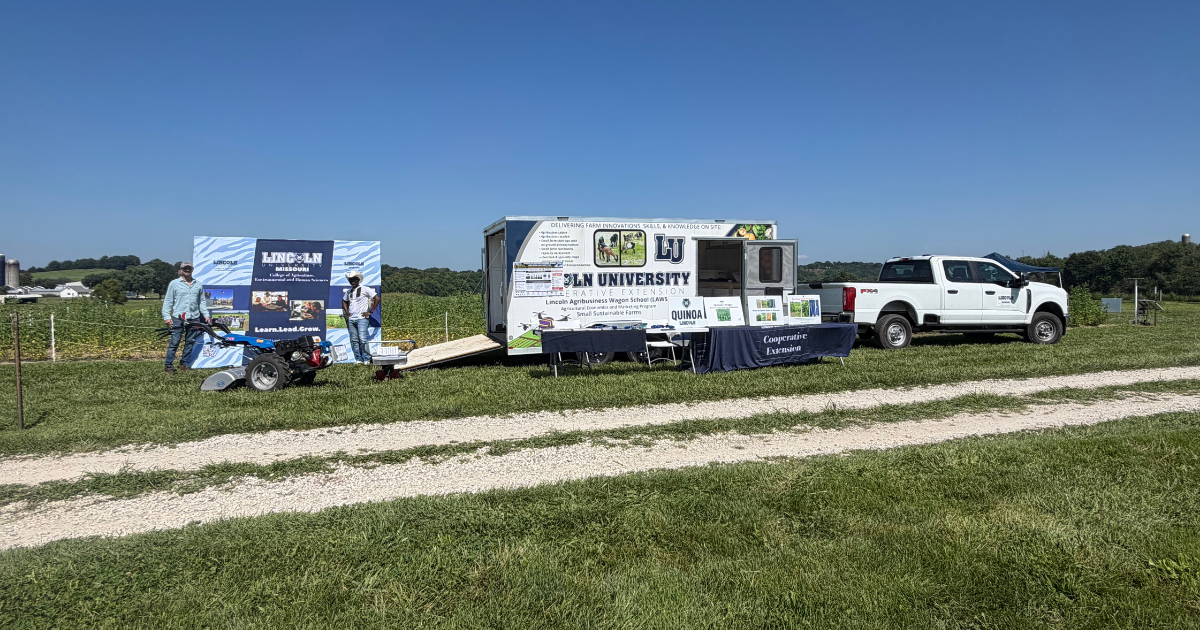 Cam Laird and Daniel Agyare stand beside the Lincoln Agribusiness Wagon School and a BCS tractor used as part of agribusiness training.
Lincoln University of Missouri (LU) Cooperative Extension offers a yearlong agribusiness certification training series designed to help farmers strengthen their business plans, improve production practices and develop strategies for bringing their products to market.
Led by Eleazar Gonzalez, Ph.D., state Extension specialist of agricultural economics and marketing, the series runs from October 2026 through September 2027. The training consists of three cohorts (sections), each focusing on a different aspect of agribusiness.
“They will learn by creating their own business plan,” Gonzalez said. “During the first [section], they will strengthen their farming purpose with clear goals and build confidence in their production plan.”
The first section, scheduled from October through May, focuses on the business side of starting and operating a sustainable farm. Eight two-hour lectures help attendees develop an agribusiness plan suited to their farming or ranching goals.
Guest speakers at each lecture share insights on sustainable farming practices and introduce participants to resources and Extension services available through LU. Follow-up activities help farmers apply information from each session as they build their plans.
The program then moves from the classroom to the field. From April through July, the second section provides hands-on training through the Lincoln Agribusiness Wagon School (LAWS), a mobile classroom designed to help new and experienced farmers learn about small-farm agribusiness innovations and technologies.
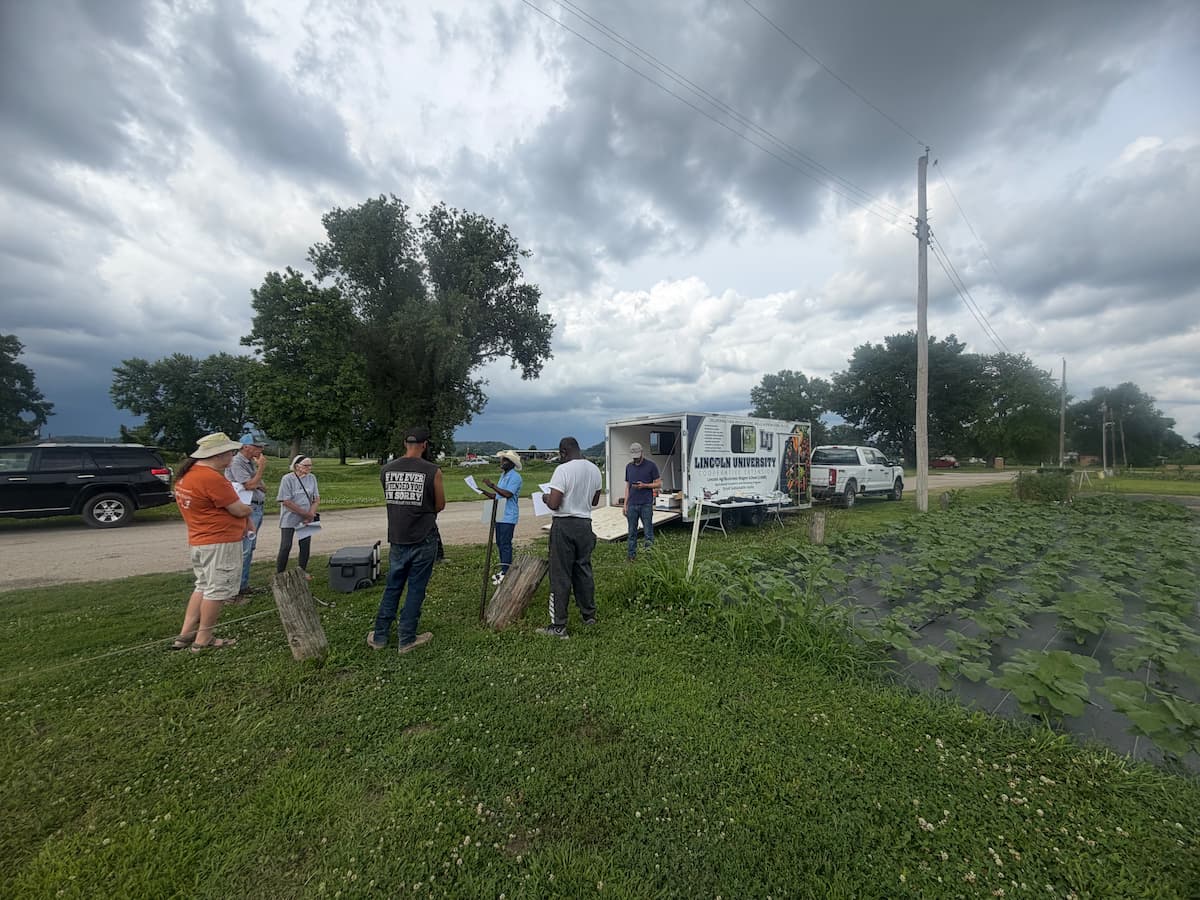 Agribusiness trainees learn sustainable farming practices from Lincoln University experts using the Lincoln Agribusiness Wagon School.
Participants learn how planning and sustainable production practices can work together on a farm.
“We are sharing with participants an innovative learning approach and practical experience that offers participants an option to turn their farming activities into a more profitable venture,” Gonzalez said.
LU provides direct assistance to 12 participating farms or gardens during the second section. Using LAWS and a two-wheeled, walk-behind BCS tractor, the program helps producers establish or improve a farming plot while exploring practices to support soil regeneration, efficiency and long-term sustainability.
Training covers equipment for small farms, BCS tractor operation, soil preparation, drip irrigation, mechanical weed control and pest management. Attendees also gain hands-on experience operating equipment and selecting which to use based on soil conditions.
While on-farm assistance remains limited, others may attend field days and learn how to operate the tractor and its implements. By connecting classroom planning with fieldwork, the program allows participants to put their developing agribusiness plans into practice.
The final section, scheduled from July through September, shifts attention toward postharvest management and marketing. It includes three sessions: value-added products, food safety and market pricing and strategies.
Through these topics, producers build skills for managing products after harvest, setting appropriate prices and identifying marketing opportunities. The training aims to help farmers strengthen cash flow while developing greater certainty about where and how they can sell their products.
Requirements across all three sections must be completed by anyone seeking certification. They must attend at least 80% of the first section’s lectures, participate in at least one farming field day, complete a field day activity at their farming location and attend at least one session from the third section. Overall, certification requires attendance at a minimum of 10 of the program’s 23 sessions or activities and completion of at least a draft agribusiness plan.
Certification, however, remains optional. Farmers and other community members are welcome to attend individual lectures or field days without completing the full series.
By September 2027, the program aims to help participating farmers complete a successful production season with stronger yields, greater market certainty and a clearer understanding of their operations. Through business education, field experience and marketing preparation, the series connects each stage of agribusiness development while helping participants build a plan they can continue to use long after completing the training.
The training series is free and open to anyone interested in attending. The form to sign up can be found here. For more information or questions about the program, contact Eleazar Gonzalez at GonzalezE@lincolnu.edu.