
Farm Tour Showcases How Diversified Agriculture Builds Stronger Operations
Office of Communications and Marketing
Young Hall
820 Chestnut Street
Jefferson City, MO 65101
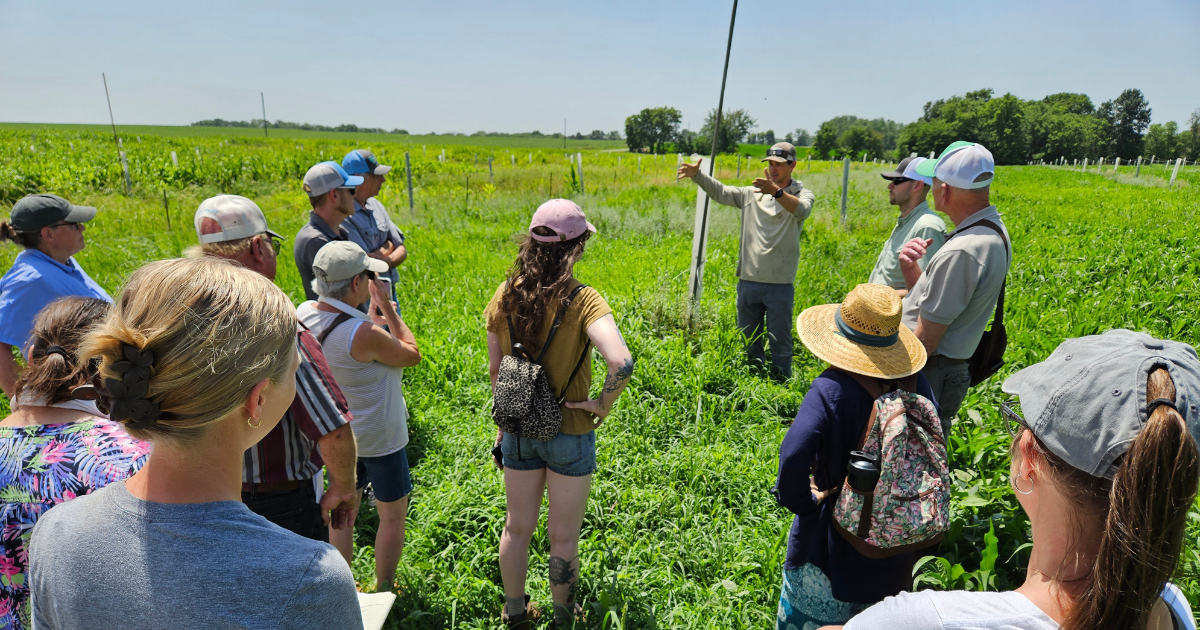 Josh Payne, co-owner of Stacked Agroforestry, explains the farm's regenerative silvopasture system during a farm tour.
Lincoln University of Missouri (LU) Horticulture Educator Nathaniel St. Clair led a June 30 tour of Stacked Agroforestry, a regenerative farm and ranch in Concordia, where participants learned about diversified agricultural production. Farmers, gardeners and landowners explored how market gardening, high-tunnel production, livestock integration and agroforestry can function together as part of a resilient, sustainable farming system. The tour offered participants an up-close look at practical strategies designed to improve productivity, strengthen environmental stewardship and vary sources of farm income.
Participants looked into chestnut groves, silvopasture systems, market garden production areas, high tunnels, sheep grazing spaces and regenerative pig operations. The tour included guided discussions, opportunities for questions and a presentation focused on soil health.
“Stacked Agroforestry is an excellent example of a diversified farming operation that integrates multiple enterprises in a practical and profitable way,” St. Clair said. “The farm demonstrates innovative approaches to agroforestry, livestock integration, and specialty crop production that can be adapted by producers throughout Missouri.”
Josh Payne, owner of Stacked Agroforestry, guided participants through the farm and shared lessons from his experience managing an operation built around interconnected agricultural practices. He explained how selecting specific forages can provide valuable nutrients for livestock during different times of year and how rotational grazing allows animals to benefit from available resources throughout the farm.
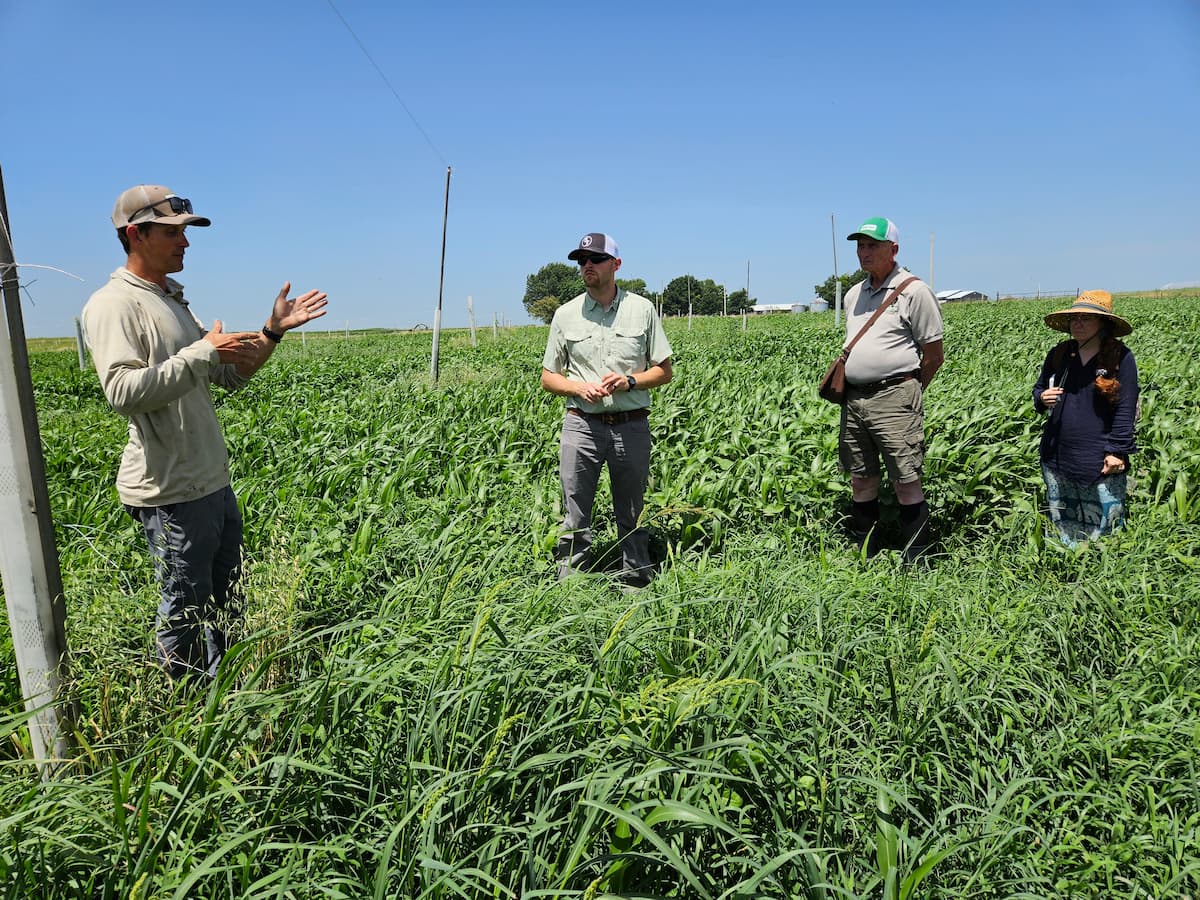 Stacked Agroforestry farm tour attendees learn how electric fencing can be used for sustainable livestock management.
The tour demonstrated how combining enterprises can maximize land use, diversify income opportunities, improve soil health and increase farm resilience. By seeing these systems operating together, participants gained a clearer understanding of how crops, livestock and conservation practices can complement one another.
“We hope all participants left with practical ideas they can apply to their own properties and a better understanding of opportunities for diversification,” St. Clair said.
Charles Hunter, vice president of the Booneville Farmers Market board, attended the event and highlighted the value of working alongside LU Extension. He said Extension programming helped him with the produce he sells at the market.
“I have four small gardens where I grow fruits and vegetables,” Hunter said. “As a regenerative, no-till, no pesticides or herbicides grower, it’s important that I find the best way to get the best product to my customers.”
Hunter said the relationship between producers and Extension professionals creates an important exchange of knowledge. Through conversations at events like the farm tour, growers can share their experiences while learning new approaches from agricultural educators.
“Any grower, rancher or value-added producer will learn something they can apply to their own operation,” Hunter said. “Going to these events is much more useful than watching a video — you can actually ask questions and get them answered in real time.”
Through hands-on educational opportunities like the Stacked Agroforestry farm tour, LU continues its commitment to supporting Missouri farmers, landowners and agricultural communities. By connecting producers with practical knowledge, innovative practices and one another, LU Extension helps strengthen local food systems and encourages sustainable approaches producers can incorporate into their own operations.