From Freedom’s Promise to the Future’s Possibilities: Lincoln University at 160
Office of Communications and Marketing
Young Hall
820 Chestnut Street
Jefferson City, MO 65101
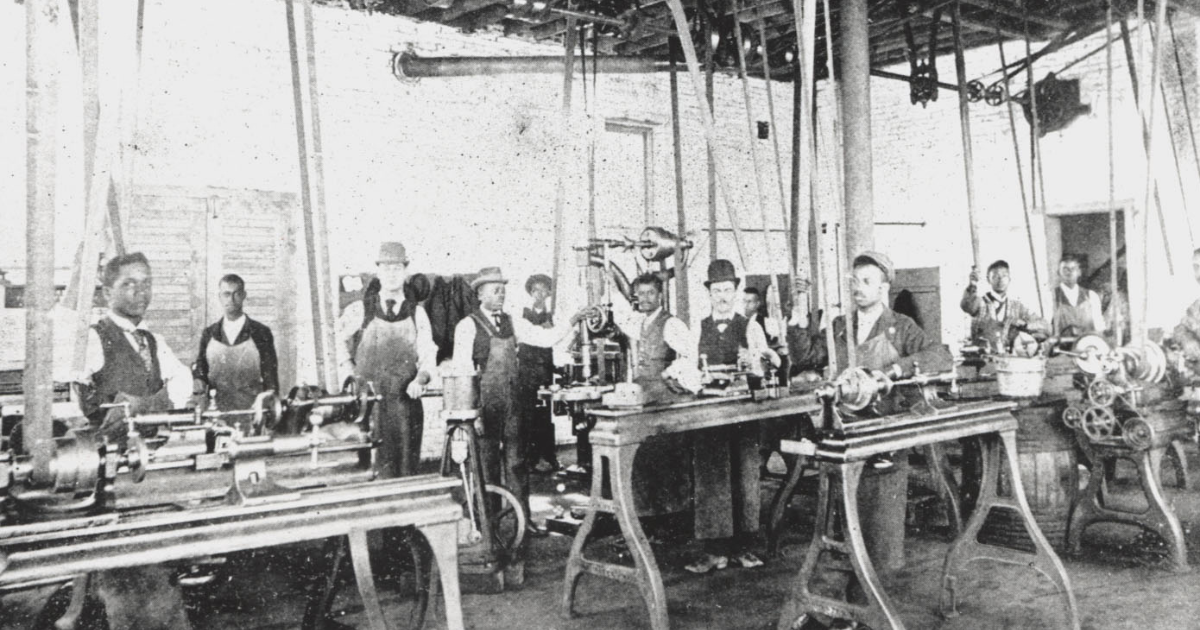 Lincoln students train in industrial trades in Industrial Hall in the late 1800s.
This article originally appeared in the Spring 2026 Alumni Line magazine. Click here to read the full magazine.
It is a story well-known to every Lincolnite — how a band of freed Black soldiers dreamed of educating the people of their home state and turned that dream into reality.
As the Civil War drew ever closer to its end in 1865, the soldiers of the 62nd and 65th Regiments of the United States Colored Troops at Fort McIntosh, Texas, began to make plans for their return to their homes in Missouri. The soldiers had learned to read and write as part of their training in boot camp, and they wanted to give that same opportunity — and more — to other freed Black people. The soldiers, whose pay averaged $13 a month, pooled their funds to found Lincoln Institute in Jefferson City. The soldiers of the 62nd came up with $5,000; those in the 65th added another $1,400 to the school’s endowment.
The men had three requirements: the institution would be located in Missouri for the benefit of emancipated African Americans with a curriculum that combined study and labor. Those founding goals have propelled Lincoln to the heights of historically Black colleges and universities.
“Those soldiers changed the lives of thousands of Black Americans — proud Lincoln alumni,” says Lincoln University President John Moseley, who was named to his current leadership role by the Lincoln University Board of Curators in 2022. “Every day that I walk onto our campus, I reflect on those soldiers. I envision the campfires where they learned to read and write with their lieutenants’ help, and I cannot help but feel the responsibility and power of their 160-year-old legacy.”
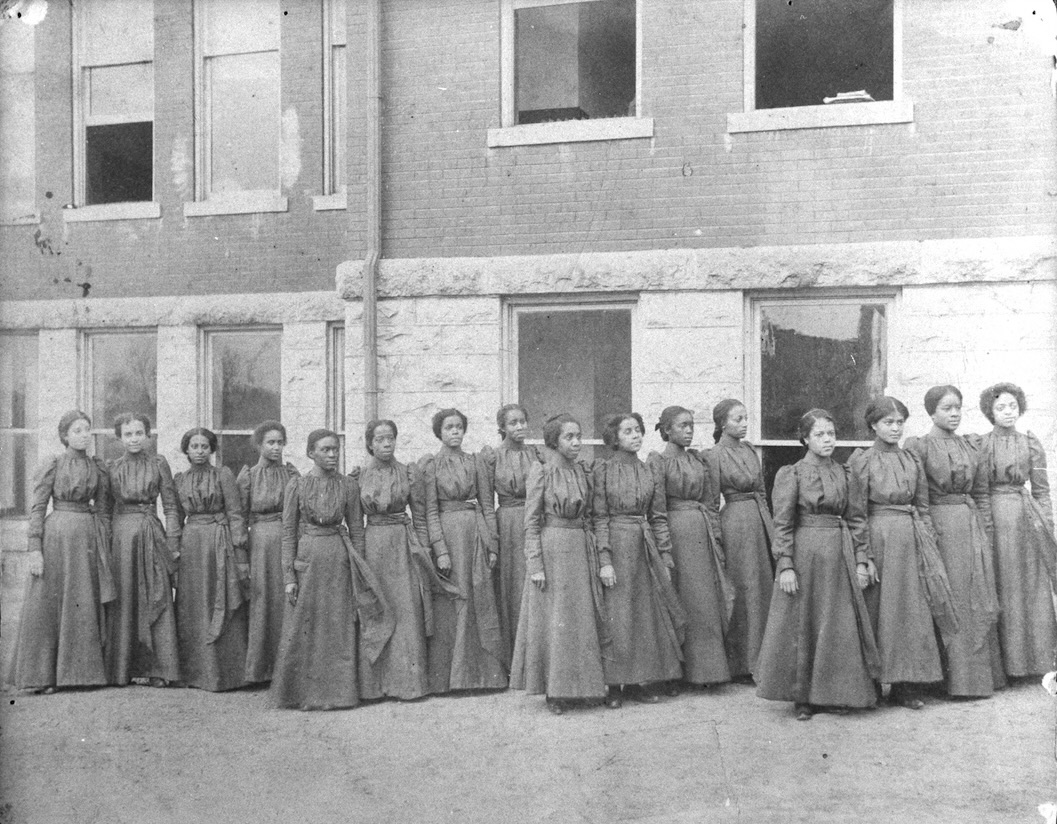 Lincoln women in the early 1900s.
Dream School
With that seed capital of $6,400, preparations moved swiftly to open Lincoln Institute the following year. Richard Baxter Foster, a former first lieutenant in the 62nd Regiment, was named first principal and sole teacher of Lincoln Institute. On Sept. 17, 1866, the school opened its doors to the first class of two students in an old frame building in Jefferson City. From there, the soldiers’ dream could only grow.
There were funding struggles early on, as Lincoln fought to keep its doors open as a private school educating Black children. Many of those early students were Jefferson City children who had no public school facilities yet; the Jefferson City Board of Education helped out by supplementing Foster’s pay. In 1870, the school began receiving state aid as well as donations from several organizations and individuals. In 1871, Lincoln Institute moved to its present campus and erected its first building. Enrollment grew to nearly 200 students, almost equally split between males and females. Lincoln dropped elementary education for local Black children when the city built schools for them and the focus turned to teacher training. The curriculum added college-level coursework in 1877, and in 1879 Lincoln formally became a Missouri public institution with the deeding of the property to the state. The Lincoln Alumni Association formed in 1876.
Inman E. Page, Lincoln’s first president, took office in 1880 and served until 1898, overseeing enrollment growth, the construction of new buildings, hiring of new faculty and an expanding college curriculum. Lincoln began to attract more students from outside Cole County, increasing its influence throughout the state. Under the second Morrill Act of 1890, Missouri designated Lincoln a land-grant institution, emphasizing studies in agriculture, mechanics and teaching.
In 1921, the Missouri Legislature transitioned the school to a four-year college and changed the name to Lincoln University. When Nathan B. Young arrived at Lincoln as its new president in 1923, he focused on the school becoming a university in more than name only. He filled faculty vacancies with Ivy League and other East Coast-educated professors to bolster Lincoln’s standing and enhance its accreditation efforts. Young traveled tirelessly across the state to better acquaint Missourians with Lincoln. Curriculum changes focused on agriculture, domestic and mechanical arts, and military science with a strong background in liberal arts. Enrollment — up and down since the turn of the century — began a steady rise in the ʼ20s and ʼ30s, nearly tripling to 468 by 1938. Students came to Lincoln from across Missouri and 10 other states, attracted by its growing reputation as “The Black Harvard of the Midwest.”
“This period is when we really started to grow and mature as an institution,” says university archivist Mark Schleer ʼ07. “Lincoln went from being a training institute founded by former slaves to a four-year university just decades later. It’s incredible. The fact that we’ve lasted this long is a tribute to the dream those soldiers had.”
Legal Precedent
The soldiers of the 62nd and 65th had dreamed big, so big that it took seven decades for someone to test the limits of that dream. Enter Lloyd Gaines, a 1935 graduate of Lincoln who sought admission to the University of Missouri Law School and was turned down solely because of his race. Gaines sued, taking the case to the U.S. Supreme Court, which ruled in 1938 that Missouri had to admit Gaines to its law school or open a law school at Lincoln. Although Gaines never attended law school — he disappeared shortly after the court’s decision — the Lincoln University Law School operated in St. Louis from 1938 to 1955, turning out many notable attorneys.
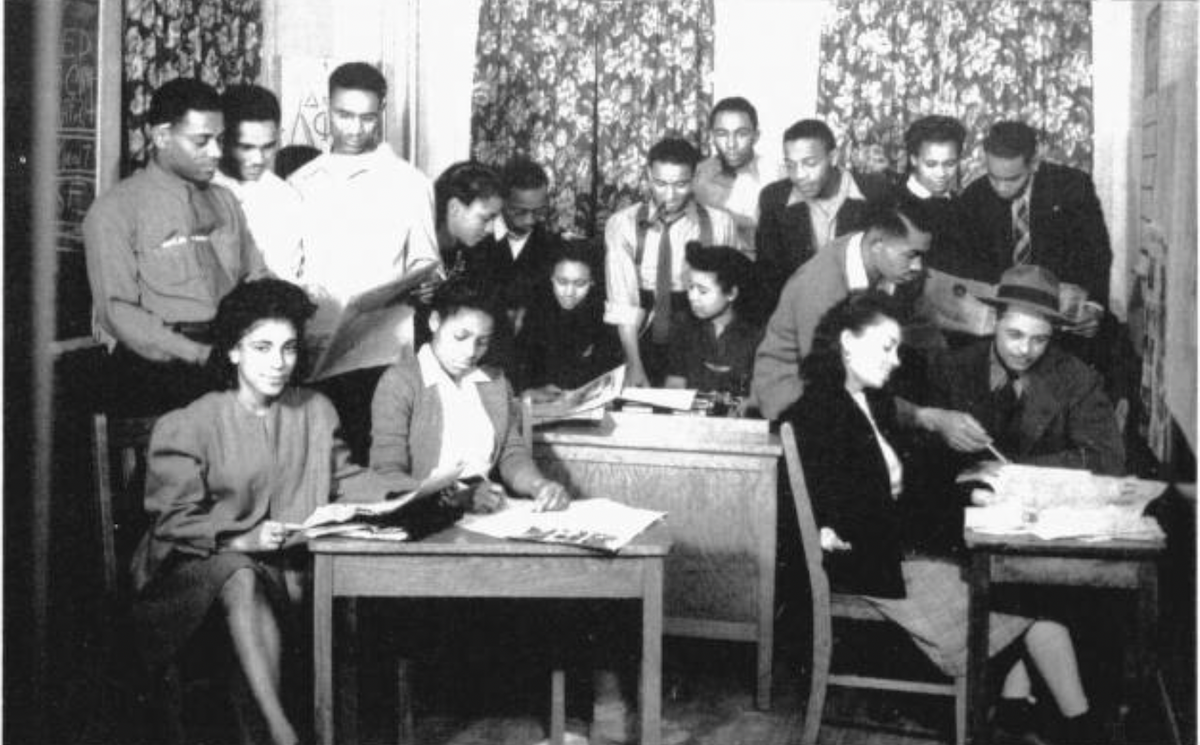 Lincoln University Clarion staff in 1942.
In 1939, the legal process repeated after University of Kansas graduate Lucille Bluford was accepted into the University of Missouri’s graduate program in journalism, only to be turned away when she showed up to register and university officials realized she was Black. She sued and won her case with the Missouri State Supreme Court in 1941. Lincoln’s School of Journalism opened in 1942.
Boom Times
Longtime university President Sherman D. Scruggs witnessed tremendous growth during his time at the helm of Lincoln, from 1938 to 1956. Graduate instruction began in the summer session of 1940, with majors in education and history and minors in English, history and sociology. The law school and journalism school opened, and a Civil Pilots Training Program developed as a feeder for army aviation schools during World War II. New construction included dormitories, a print shop, buildings for agriculture and mechanical arts, a gymnasium and Inman E. Page Library.
In 1954, following the Supreme Court decision in Brown vs. Board of Education declaring segregated public schools unconstitutional, Lincoln University opened its doors to all who could meet its entrance criteria, regardless of ethnicity. Enrollment climbed from 400 to nearly 1,200 students, triggering a move to expand curriculum and facilities.
Although the lion’s share of Lincoln students chose majors in elementary education and business administration, the university forged on with new degree offerings in accounting, speech pathology and audiology. It established a nursing school in 1968, now considered one of the best in Missouri.
A building boom in the early ʼ70s saw the construction of a new football stadium and another dormitory— Tower Hall (now called Dawson Hall), still the tallest building on campus. Newly erected campus radio station KLUM (now KJLU) hit the airwaves in 1973.
James Frank was the first Lincoln alumnus to become president of the university, serving from 1973 to 1982. During his tenure, Lincoln University enhanced its land-grant status with the Cooperative Extension Center and acquired additional farm property. The Frank administration also developed a broadcast journalism program and began training students at campus television station JCTV. The nursing school expanded in 1989, opening a satellite campus at Fort Leonard Wood.
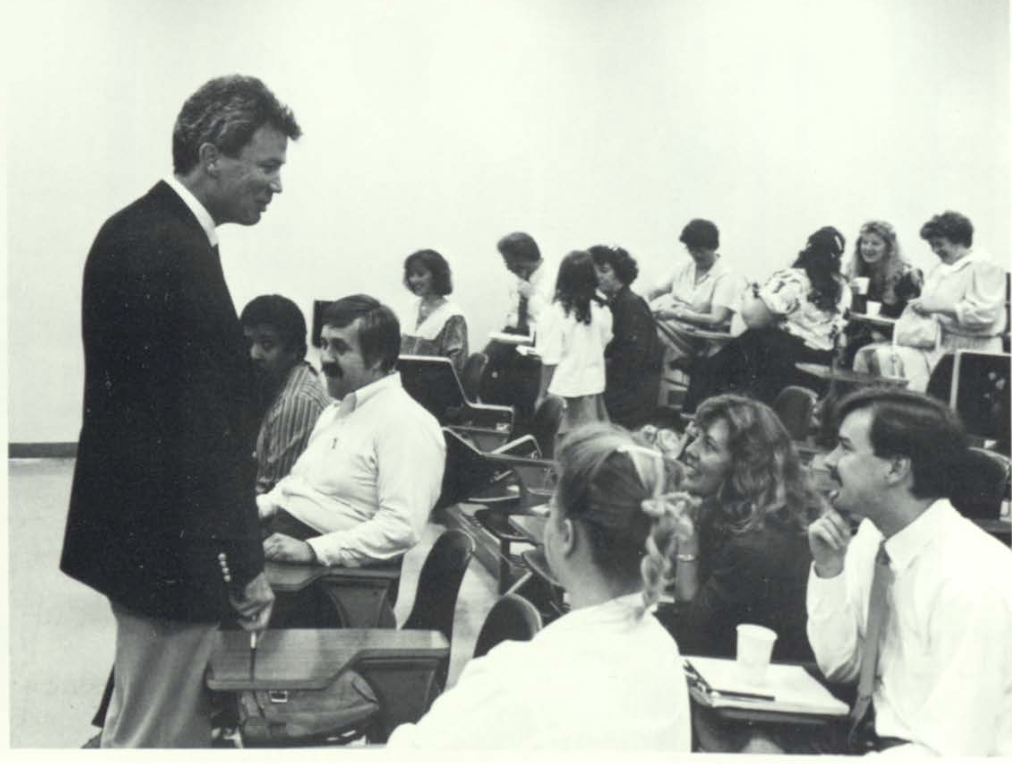
Students in the Lincoln Department of Education participate in a classroom discussion in 1989.
Surging into the New Century
The 1990s saw the growth and integration of nursing, teacher education, computer science and agribusiness into Lincoln’s core offerings. As the school made its way into the 21st century, Lincoln enjoyed a resurgence in athletic programs and technological advancements, both in and out of the classroom. When Carolyn Mahoney arrived as Lincoln’s first female president in 2005, she established programs in library and information science, environmental science, aquaculture and social work. Expanding the facilities for the nursing program prompted a sharp rise in nursing school enrollment.
A partnership with Jefferson City brought the LINC Recreation and Wellness Center to campus in Lincoln’s 150th year. The state-of-the-art fitness center is open to all students and employees.
The past five years at Lincoln have seen a burst of expansion with new programs and new facilities, feeding the growth of academic quality and value. The university launched its Law Enforcement Training Academy in 2021, the first and only historically Black college or university to house its own police academy; it now operates in four Missouri locations. In 2022, the School of Nursing opened a new facility in St. Robert, a simulation lab to enhance the program at Fort Leonard Wood. That same year, Lincoln expanded its outreach into Jefferson City Correctional Center with its prison education program, offering inmates a path to acquire a Bachelor of Liberal Studies degree.
As a land-grant university, agriculture is a strong component of LU’s curriculum. Now recognized as a Research College and University under the 2025 Carnegie Classifications, a designation that follows a significant investment of more than $9.1 million annually in research expenditures from fiscal years 2021 to 2023, reinforcing LU’s commitment to scientific advancement and higher learning. Lincoln is serving emerging needs in agriculture, sustainability and related sciences, with research initiatives in aquaculture, the Hemp Institute, small ruminant production and organic farming.
“Every day that we exist, we prove we can do more to better serve our students, faculty, staff and community,” Moseley says.
Academic programs are flourishing at Lincoln, providing access to a wider cross-section of learners, with new offerings that include online master’s degrees in business, education and more.
The LU Employment Academy launched in 2025 to prepare students for the workforce while addressing Missouri’s employment needs. The two-semester certificate program combines online coursework with hands-on internships.
The Security Sciences Institute (SSI) offers certificate programs in cybersecurity, mental health for first responders, emergency medical technician and geospatial information science for students in Jefferson City and LU’s Fort Leonard Wood/St. Robert campus.
The SSI certificate programs will be housed in Lincoln’s new Health & Security Sciences Institute (HSSI) building when it is completed in fall 2026. The $45 million facility will also provide a training center for emergency operations, security and crisis response teams as well as an expansion of the School of Nursing.
Today, 160 years after its founding, Lincoln University of Missouri serves a diverse population of more than 2,250 undergraduates and graduate students, both residential and nonresidential, and offers an array of academic programs, research projects and public services. The university grants associate, bachelor’s and master’s degrees in more than 45 areas of study, plus certificates in education, security sciences, healthcare and more. The university’s impact reaches far beyond anything that the soldiers of the 62nd and 65th Regiments dreamed.
We extend a special thank you to the LU Archives for their assistance and for providing the photographs featured in the 160th anniversary story.