
Lincoln University Extension Specialist Receives Outstanding Project Award
Office of Communications and Marketing
Young Hall
820 Chestnut Street
Jefferson City, MO 65101
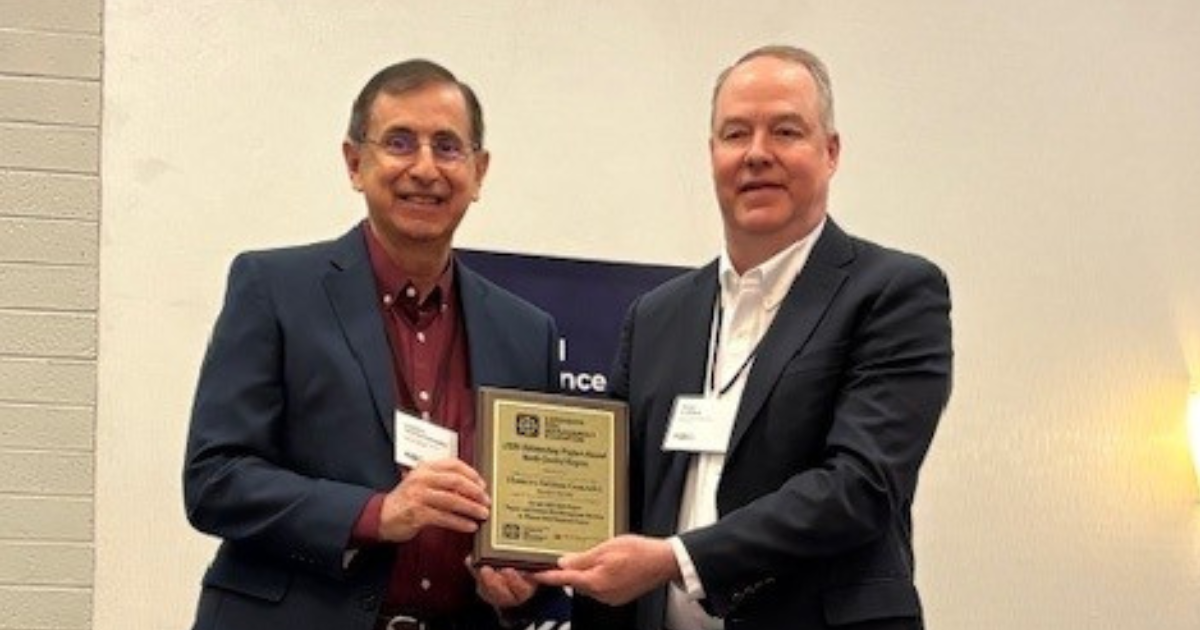 North Central Extension Risk Management Education Center Director Brad Lubben presents LU’s Homero Salinas-Gonzalez with the 2026 Outstanding Project Award.
Lincoln University of Missouri’s (LU) Homero Salinas-Gonzalez received the North Central Extension Risk Management Education Center’s (ERME) 2026 Outstanding Project Award in April at the ERME National Conference in Nashville, Tennessee.
ERME is funded through the United States Department of Agriculture’s (USDA) National Institute of Food and Agriculture. The organization provides funding to public and private organizations for educational projects meant to build agricultural producers’ ability to manage and mitigate risk to their operations.
Salinas-Gonzalez, associate professor and state extension specialist for small ruminants, received the award for his ERME-funded project, “Pasture and Livestock Risk Management Education for Missouri Small Ruminant Farmers.”
“It’s very meaningful to me," Salinas-Gonzalez said. "As an immigrant, it’s hard to be known here, to start getting grants. Nobody knows you, and you have to earn trust if you want to get funding. And as far as I know, this was the first grant for Lincoln University from this agency, and I was the one to receive it.”
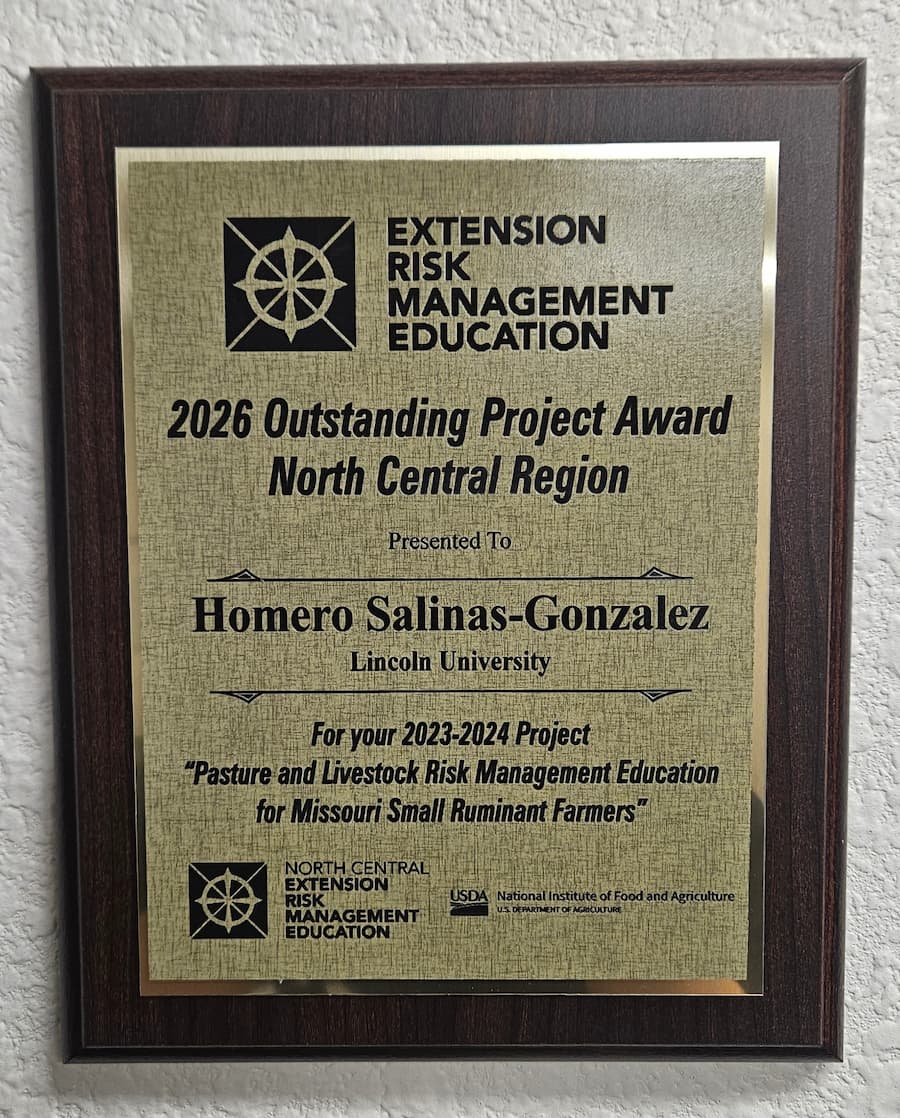 LU’s Homero Salinas-Gonzalez received the 2026 Outstanding Project Award for his project, “Pasture and Livestock Risk Management Education for Missouri Small Ruminant Farmers.”
His project was among 23 others up for the 2026 Outstanding Project Award in the North Central Region, which includes Illinois, Indiana, Iowa, Kansas, Michigan, Minnesota, Missouri, Nebraska, North Dakota, Ohio, South Dakota and Wisconsin.
Salinas-Gonzalez explained that his project sought to help small ruminant producers mitigate risk in their operations through in-person and online education. Using webinars, field days, web tools and online learning modules, the project gave producers functional knowledge and resources to aid in managing livestock and pastures, building business skills and mitigating risk.
Beginning in 2023-2024, Salinas-Gonzalez’s project was built on collaboration. While at a conference in Omaha, Nebraska, Salinas-Gonzalez saw a poster by Ryan Fuez, assistant professor of applied economics at Utah State University. The poster highlighted a web-tool designed to help educate producers on the USDA’s Pasture, Rangeland and Forage (PRF) insurance. PRF insurance covers perennial pasture, rangeland or forage used to feed livestock and reimburses farmers when rainfall falls below average rates in a selected period.
The tool allows producers to input region and farm-specific information and analyze the costs and benefits of PRF insurance, helping to decide which policy options are best for their operations.
Seeing this as a valuable asset for Missouri producers, Salinas-Gonzalez partnered with Fuez to create a version of the tool catered towards Missouri small ruminant producers. With the support of an ERME grant, Salinas-Gonzalez and Fuez began their series of field days and webinars, serving producers with financial resources from Fuez’s tool and knowledge on animal health and pasture management from Salinas-Gonzalez.
In addition to partnering with Fuez, Salinas-Gonzalez added that farmers were instrumental to the project’s success.
“The other part of the partnership was with the farmers," Salinas-Gonzalez said. "With one farmer, we did a field day. Another farmer started doing training for other farmers. We started going to the Goat Expo as part of this as well."
He said the project was constantly evolving, using producer feedback to assess what information was most important to farmers and catering resources to fit those needs.
“It was a really multifaceted project,” Salinas-Gonzales said. “We spent every dollar well, working with the farmers, working with other universities, doing field days here. I was even invited to go to Kansas to do two workshops over there because they liked what we were doing.”
In ERME’s recognition of Salinas-Gonzalez, the organization noted over 220 producers participated in the project’s field days, workshops and webinars, with another 100 engaging independently through the online learning modules and tools. 114 producers began using pasture stick tools to assess stocking rates, 147 adopted parasite prevention tools and 33 producers began implementing full strategic business plans.
“Overall, the effort successfully increased both knowledge and practical adoption of tools supporting pasture management, animal health, weather risk mitigation and long-term business planning,” the organization said in a statement.
While still running the “Pasture and Livestock Risk Management Education for Missouri Small Ruminant Farmers” project, Salinas-Gonzalez also worked with collaborators to produce a publication aimed at educating farmers on value-added products titled, “Adding Value to Sheep, Goats, Beef Meats and Chicken: Butchering, Processing, Regulations and Marketing.”
Now, both projects are completed, but Salinas-Gonzalez’s work continues. Under a North Central Region Sustainable Agriculture Research and Education grant, Salinas-Gonzalez is currently focused on taking the information from these former, Missouri-focused projects and sharing them with the broader North Central Region.
Salinas-Gonzalez’s projects align with Lincoln University’s ongoing mission to elevate the agricultural industry and especially small, limited-resource farmers. His efforts are mirrored and aided by colleagues at LU, including researchers, students and other Extension specialists.
“Here at Lincoln, you get a lot of support doing this,” Salinas-Gonzalez said. “I have felt a lot of respect and support.”