
Hands-On Grafting Workshop Teaches Missouri Growers the Science of Fruit Production
Office of Communications and Marketing
Young Hall
820 Chestnut Street
Jefferson City, MO 65101
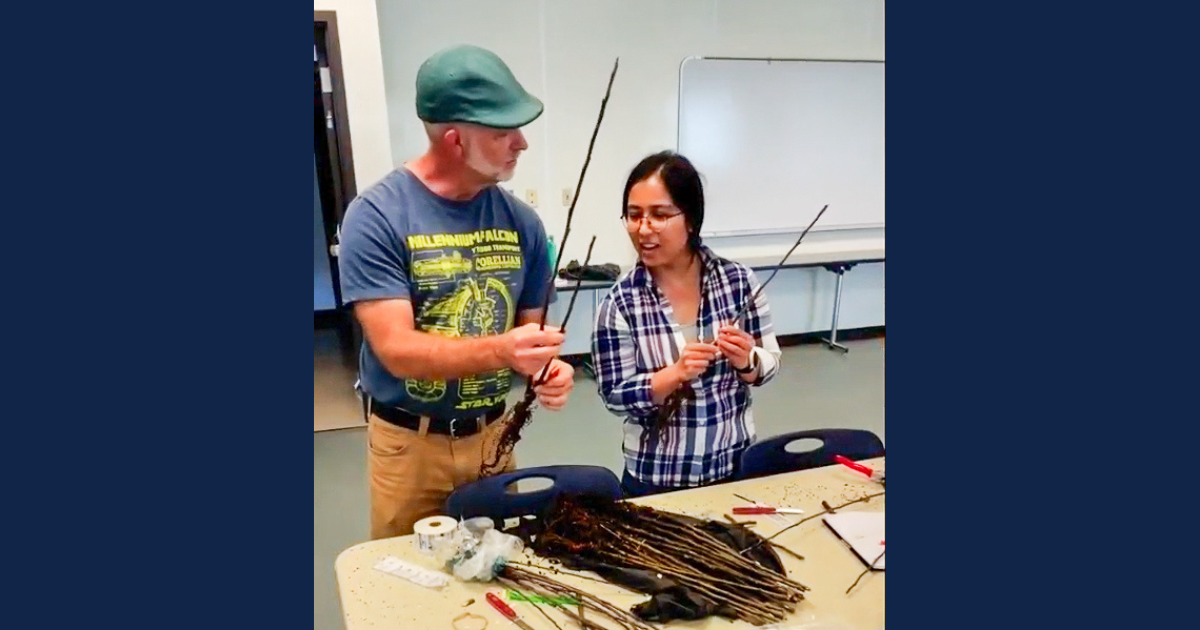 Two attendees discuss proper technique during a Bench Grafting Workshop at LU’s George Washington Carver Farm.
Lincoln University of Missouri (LU) Extension brought together farmers, gardeners and students in late April for a Bench Grafting Workshop at LU’s George Washington Carver Farm. Led by Giuma Abusrewil, the workshop provided hands-on instruction in fruit tree propagation.
Abusrewil, a professor of horticulture specializing in fruit tree production with LU’s Innovative Small Farmers’ Outreach Program, began by explaining grafting as the practice of taking a small section of one plant and connecting it to the top of another plant stem (rootstock) to make a single, unified plant. They can be the same type of plant or different types within the same species. He then introduced the fundamentals of fruit tree grafting, including proper preparation.
“Before you graft, check your soil,” Abusrewil said. “We have a lot of problems with soil, like drainage, diseases and nematodes.”
Participants learned the process begins by selecting a scion — a dormant, young bud wood taken from a desirable fruit tree variety — and pairing it with a compatible rootstock. Abusrewil explained how grafting can offer several benefits, including producing multiple fruit varieties on one tree, controlling tree size and improving adaptation to different soil conditions using specialized rootstocks. He told attendees that newly grafted trees must be handled carefully.
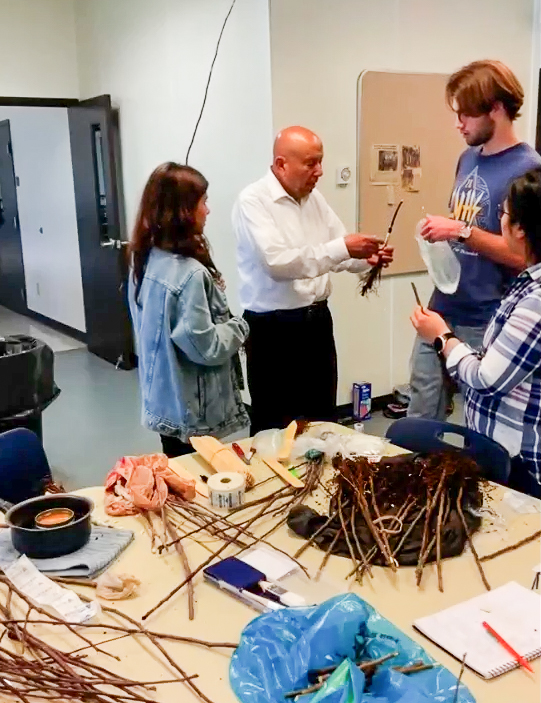 Giuma Abusrewil demonstrates to a small group of grafting workshop attendees how to properly join the parts of their apple tree seedlings.
“After grafting, the seedlings should be kept at 70 degrees for four weeks to allow callusing,” Abusrewil said. “The callus helps the parts of the tree fuse together and closes the open space between them.”
While demonstrating the appropriate grafting technique, Abusrewil used four apple varieties: Gala, Liberty, Arkansas Black and Pristine. Each participant selected their preferred variety and practiced the grafting process themselves. Afterward, they potted and labeled their grafted trees and placed them into storage, where they will remain during the four-week callusing period. If a graft does not successfully take, participants will have the opportunity to try again late this summer.
Throughout the workshop, Abusrewil emphasized the importance of using correct agricultural terminology while working in fruit production.
“For fruit trees, we always say they’re in an orchard,” Abusrewil said. “A field is for crops, a vineyard is for grapes.”
Abusrewil also shared the story of a small farmer who repeatedly reached out in hopes of learning how to replicate successful fruit trees in his area. Excited by the farmer’s interest, Abusrewil provided him with three seedlings so he could practice grafting.
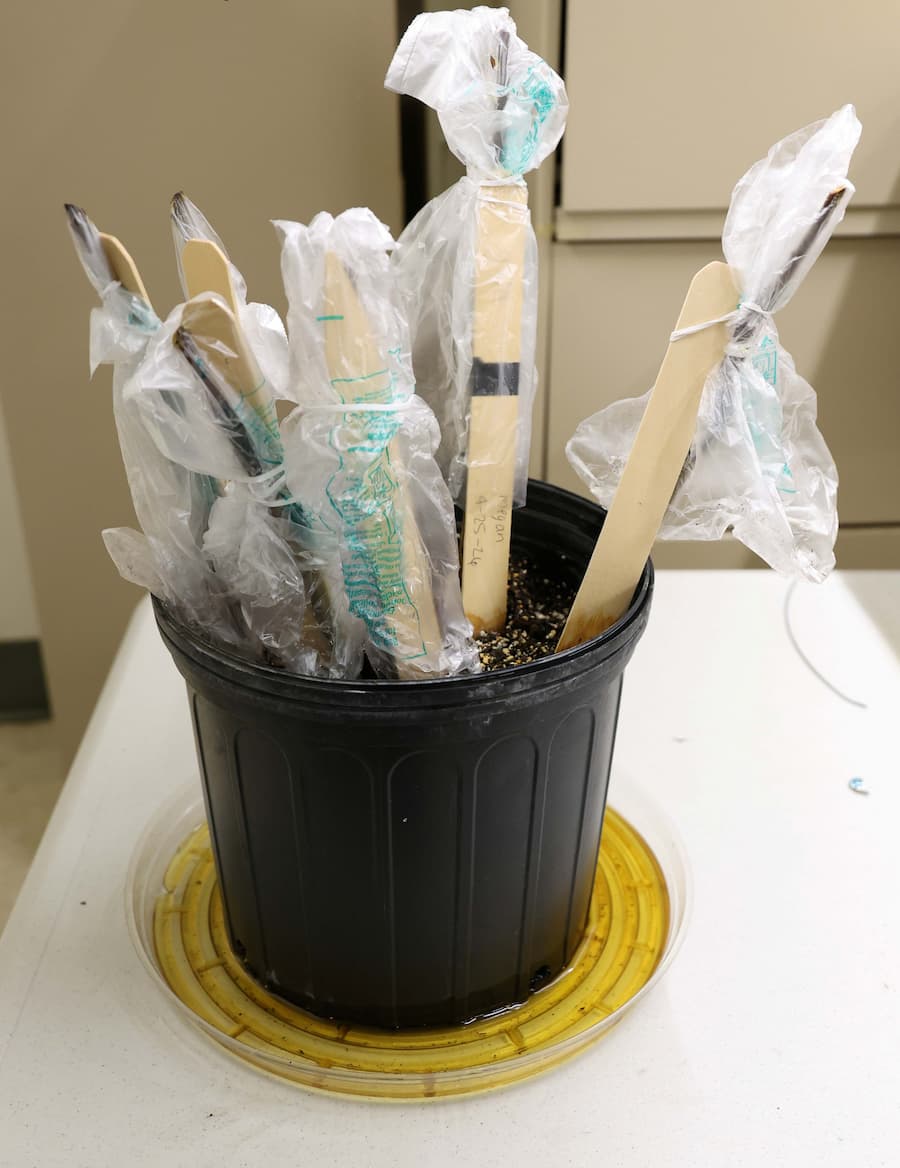 Arkansas Black apple tree grafts in a greenhouse pot.
“I am always happy to offer help, including more workshops across Missouri for farmers, gardeners and students,” Abusrewil said. “Depending on interest, I can offer topics such as grafting, pruning, planting, harvesting and fruit storage.”
With the workshops still fresh, participants now wait to see whether their grafts successfully callus and develop into healthy young trees.
Through programs like these, LU Cooperative Extension continues to provide practical, research-based education helping Missouri communities build agricultural knowledge, expand economic opportunities and make healthier food choices through local food production.
For more information on workshop availability, contact Giuma Abusrewil at AbusrewilG@lincolnu.edu.