
Lincoln University Showcases Research and Innovation at ARD Symposium
Office of Communications and Marketing
Young Hall
820 Chestnut Street
Jefferson City, MO 65101
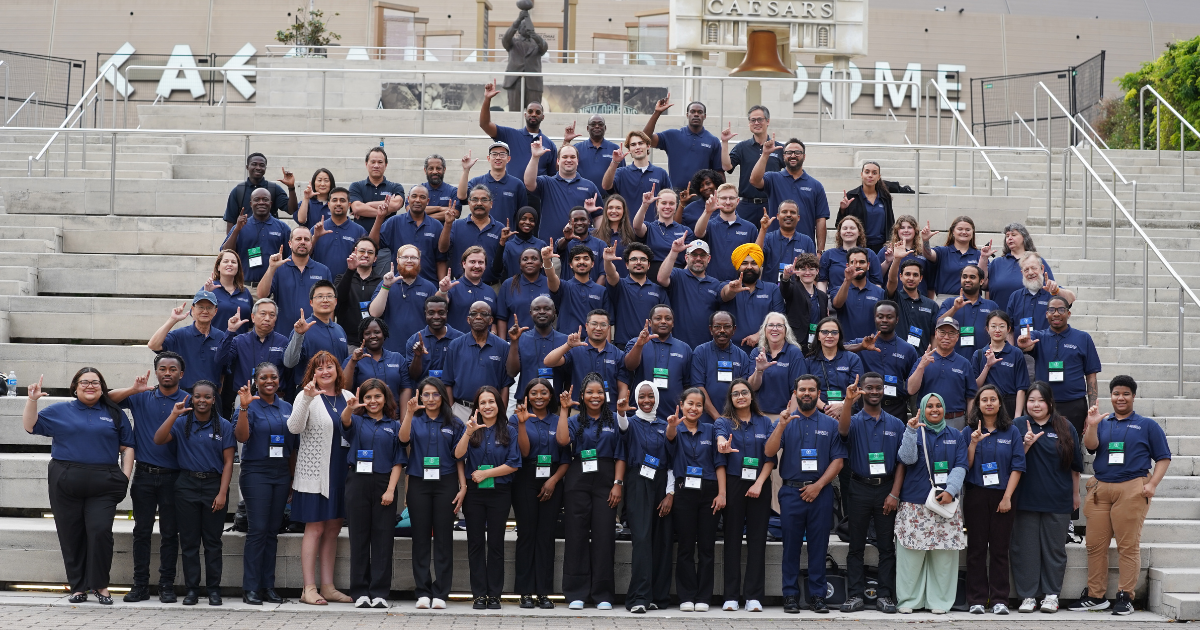 Faculty, staff and students from Lincoln University hold up their right hands in a symbolic “L” while attending the ARD Research Symposium in New Orleans.
Lincoln University (LU) faculty and students showcased their work in March at the 2026 Association of 1890 Research Directors (ARD) Research Symposium.
The ARD Research Symposium is a national, biennial research showcase funded by the U.S. Department of Agriculture’s National Institute of Food and Agriculture (USDA-NIFA), bringing together scholars from 1890 land-grant institutions across the country.
Now in its 22nd iteration, the event highlights projects supported by USDA-NIFA’s Evans-Allen Research Capacity Grant program.
Faculty researchers with projects funded by these grants are required to present summaries of their work, contributing to the broader conversation around agricultural advancement. Presentations span six key areas, including plant and animal systems, food safety and nutrition, community and economic development, natural resources and agricultural technology.
LU students also had the opportunity to attend and present their research projects. Cooperative Research Program Coordinator Amy Bax played a central role in preparing student participants, ensuring abstracts and posters met required standards while also keeping students safe and supported throughout the trip.
“The conference hotel was walkable, and a grocery store was close by; we also arranged a shuttle bus to and from conference, so no one had to walk at night,” Bax said.
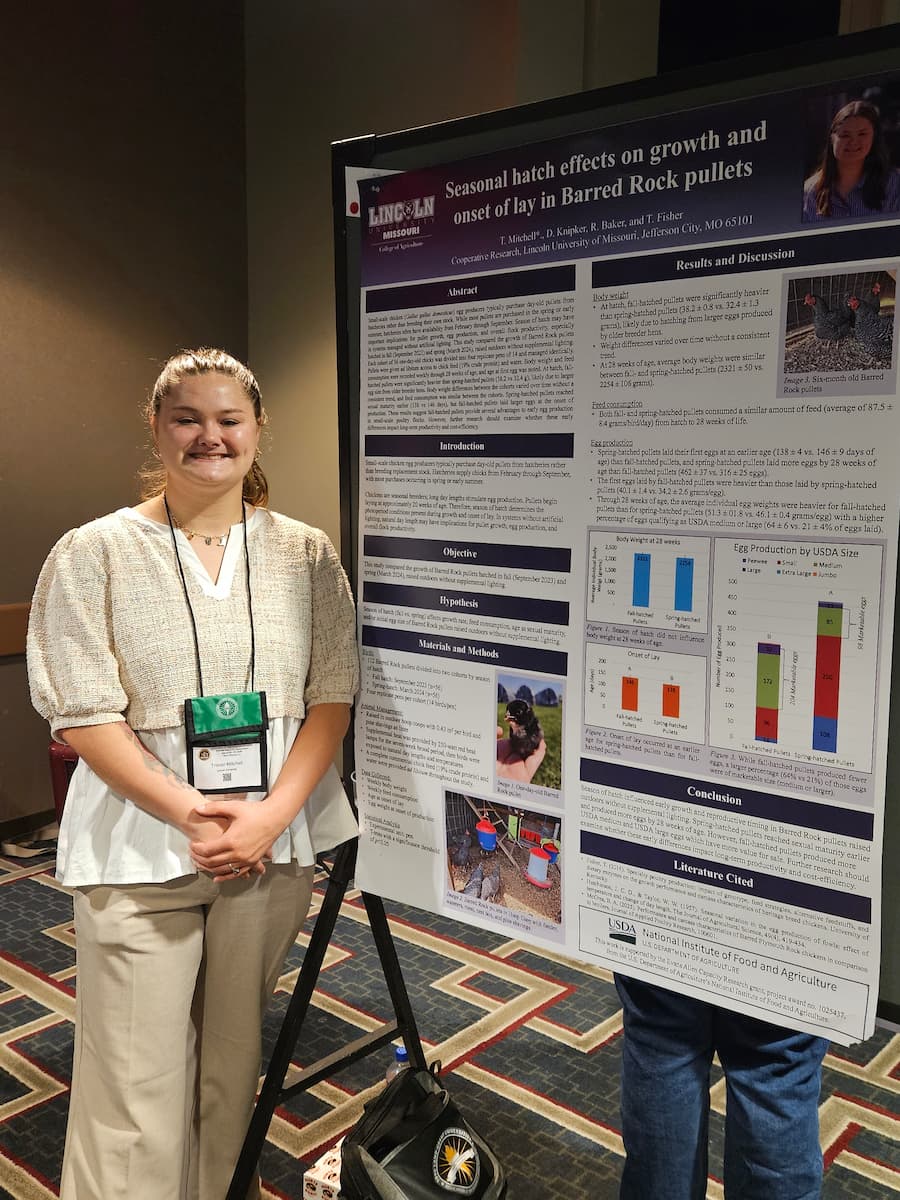 Undergraduate student Tristan Mitchell, standing next to her poster presentation titled “Seasonal hatch effects on growth and onset of lay in Barred Rock pullets.”
Graduate student Benjamin Owusu represented LU at the symposium by delivering an oral presentation of his research. This was Owusu’s first time attending ARD, and while he did not receive an award for the presentation, he said the feedback from faculty members was encouraging.
“The LU faculty that attended my oral presentation praised me for my skills and how well I was able to simplify my research,” Owusu said. “Some expected me to win an award, which was encouraging.”
In addition to his presentation, Owusu participated in the symposium’s Hackathon competition, where teams of students analyzed large-scale datasets without prior knowledge of the information provided. The event challenged participants to address issues related to agricultural systems, technology and climate sustainability through data science and collaborative problem-solving. Owusu’s team placed third out of 10 competing teams.
Alyssa Brown, a freshman studying under Dr. Victoria Uyanga, earned second place in the animal health category for her poster presentation. Brown’s was one of two awards earned by LU students at the symposium.
“I had some experience with giving presentations to my peers and professors, but this was the first time I had ever attended an event this large,” she said.
Attending ARD introduced students to new experiences, including traveling on university business and presenting at a national conference. Brown was one of three students under Uyanga’s mentorship presented at the symposium. Their achievements reflect both individual dedication and structured preparation within LU’s academic programs.
“It’s a great and rewarding experience as an adviser to have your students excel at their work, especially when leveled against several other students from other higher education institutions,” Uyanga said.
Uyanga said integrating hands-on learning opportunities into her classroom plays an important role in preparing students for opportunities like ARD.
“For my classes, I incorporate course-based research experiences, which provide students the opportunity to conduct research, gather and analyze their data, develop their summaries and share them as class presentations,” she said.
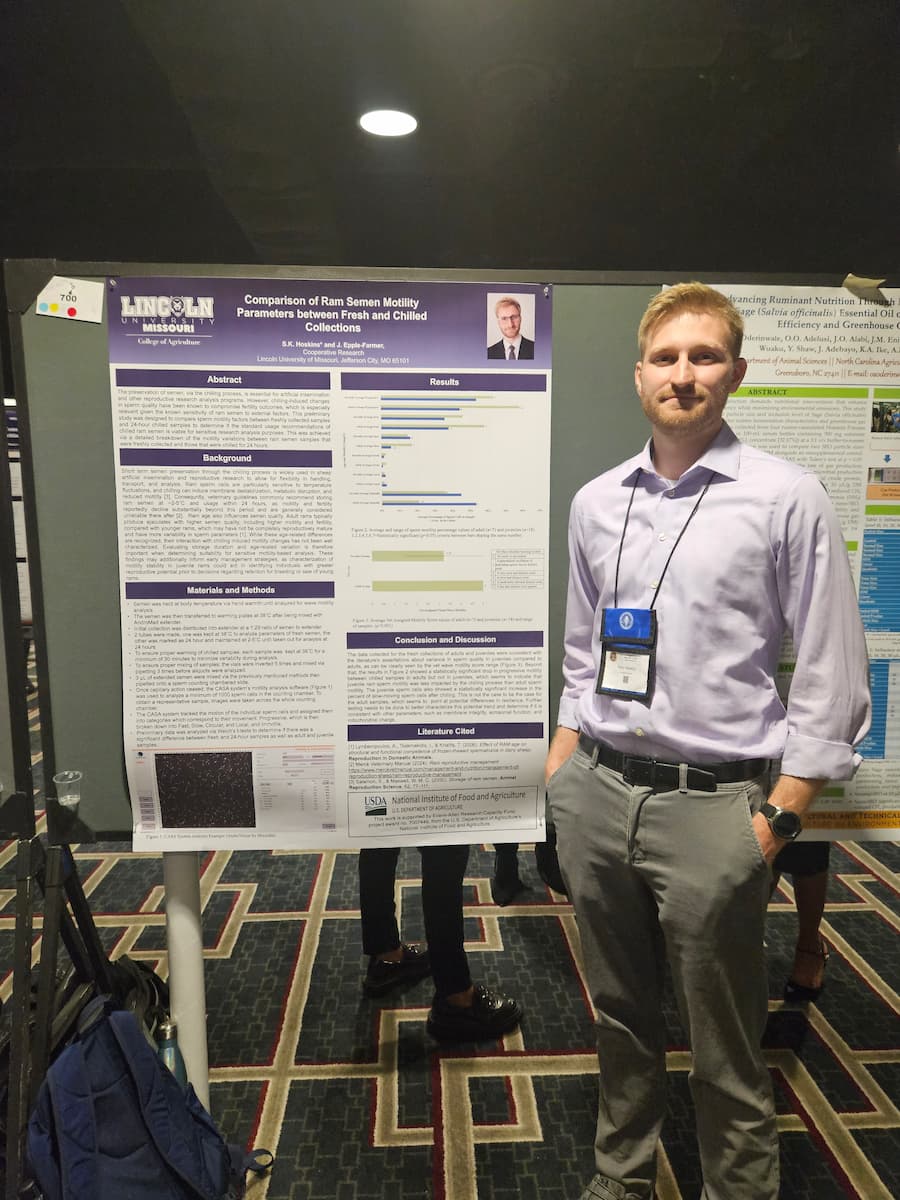 Graduate student Spencer “Kelly” Hopkins, standing next to his poster presentation titled “Comparison of Ram Semen Motility Parameters between Fresh and Chilled Collections.”
Jessica Epple-Farmer, assistant professor of animal science, brought her graduate student Spencer “Kelly” Hoskins to the symposium. She noted the value of consistent engagement with research.
“Kelly and I talk about his project almost every day,” Epple-Farmer said. “By bringing him to ARD, I gave him the opportunity to be himself and shine in his accomplishments and knowledge.”
Tatijana Fisher, state extension poultry specialist, brought both an undergraduate and a graduate student to present their research.
“Seeing my students present at a national scientific conference is incredibly meaningful,” Fisher said.
Fisher added that participation in national conferences equips students with skills extending beyond traditional coursework, fostering confidence and adaptability in professional environments.
“Students develop skills in real-world scientific communication, including the ability to think on their feet when answering questions and gaining confidence when engaging with experts in their field,” she said.
The symposium also provided LU faculty with valuable opportunities to expand their research networks and explore emerging innovations.
John Yang, professor of environmental soil chemistry, emphasized the value of exposure to new technologies and ideas. He received the Walter Hill Distinguished Service Award for his sustained contributions to the 1890 land-grant research mission.
“It was rewarding to engage with fellow researchers and see LU students succeed at such a high level,” Yang said.
Johnnie Westbrook, Ph.D., dean of LU’s College of Agriculture, Environmental and Human Sciences, attended the symposium alongside university researchers, highlighting the institution’s broader commitment to preparing students for careers in agriculture and science.
“We are preparing the next generation of agricultural scientists to solve complex and global agricultural problems,” Westbrook said. “Our students are using modern agricultural technologies to conduct research such as virtual fencing, global positioning systems, drones and artificial intelligence.”
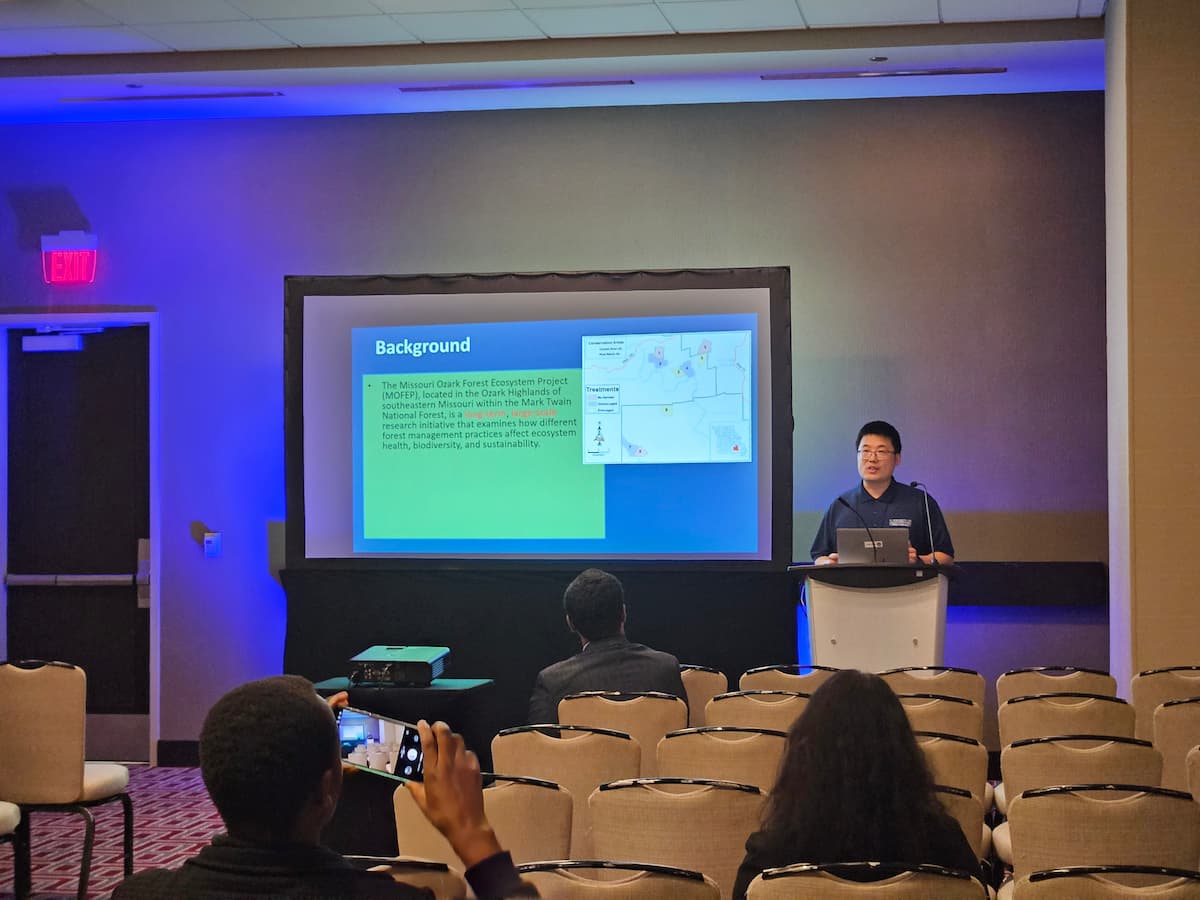 Xukai Zhang giving his oral presentation titled "A Multi-Scale Framework for Forest Inventory and Structural Assessment Using Airborne and UAS LiDAR in Missouri’s Ozark Forests."
Westbrook said the symposium also offered a valuable opportunity to observe how institutions across the country are developing future leaders in agriculture.
“I enjoyed seeing how universities are training passionate scholars who will use their research skills to become productive agricultural scientists,” he said.
The ARD Symposium strengthened individual research efforts while fostering interdisciplinary collaboration and innovation, exposing LU participants to new methodologies and reinforcing effective approaches to student mentorship.
LU plans to continue building on the momentum generated at this year’s symposium by increasing student involvement, expanding research initiatives and encouraging faculty-student collaboration across disciplines. University leaders also aim to grow research initiatives by pursuing new funding opportunities, strengthening partnerships with other 1890 land-grant institutions and incorporating emerging technologies into ongoing projects.