
International Symposium Highlights Shared Efforts in Agriculture and Food Security
Office of Communications and Marketing
Young Hall
820 Chestnut Street
Jefferson City, MO 65101
 Lincoln University of Missouri students attend the "Monitoring Emergent Plant and Animal Diseases for Food Security in the Americas" symposium on November 6.
More than 700 people came together on November 6 both in person and online, for the sixth “Monitoring Emergent Plant and Animal Diseases for Food Security in the Americas” symposium, hosted by Lincoln University of Missouri (LU) and its international collaborators.
The ongoing symposium series aims to unite experts and communities across borders to address two major goals: confronting new and emerging plant and animal diseases that threaten agricultural stability and developing a globally educated workforce capable of tackling food security challenges on an international scale. Since the series began, more than 1,250 participants from 20 countries have joined.
“I hope for attendees to leave with a better understanding of the current issues and diseases in the global agricultural scene,” said Jessica Epple-Farmer, an LU collaborator and one of the event organizers.
Open to the public, the event drew in students, farmers, extension agents, university faculty and research professionals. Attendees learned about some of the most pressing agricultural issues currently affecting food systems, while also gaining new perspectives from colleagues in other countries.
“This symposium allows attendees to learn about the multiple relevant diseases in plants and animals while also learning about perspectives of individuals in the agricultural field from many different countries,” said Jessica Epple-Farmer, an LU collaborator and one of the event organizers.
This year’s lineup of speakers represented institutions from both the United States and Latin America. A representative of Alabama A&M University, Dr. Clement Akotsen-Mensah, discussed root rot and damping off in cowpeas and other legumes. Dr. Waana Kaluwasha from Lincoln University of Missouri presented on diseases of cucurbits such as cucumber, squash and melon. From Guatemala’s Ministry of Agriculture, Dr. David Orellana, DVM, shared information about the reemergence of screwworm, a long-standing issue in livestock management. Colorado State University’s Dr. Jason Lombard, DVM, MS, addressed highly pathogenic avian influenza (HPAI) in dairy cattle, a topic that has gained national attention in recent months.
LU partners in Guatemala, Mexico and, for the first time, Colombia, hosted viewing rooms where groups could gather to participate in the webinar and discuss the presentations together.
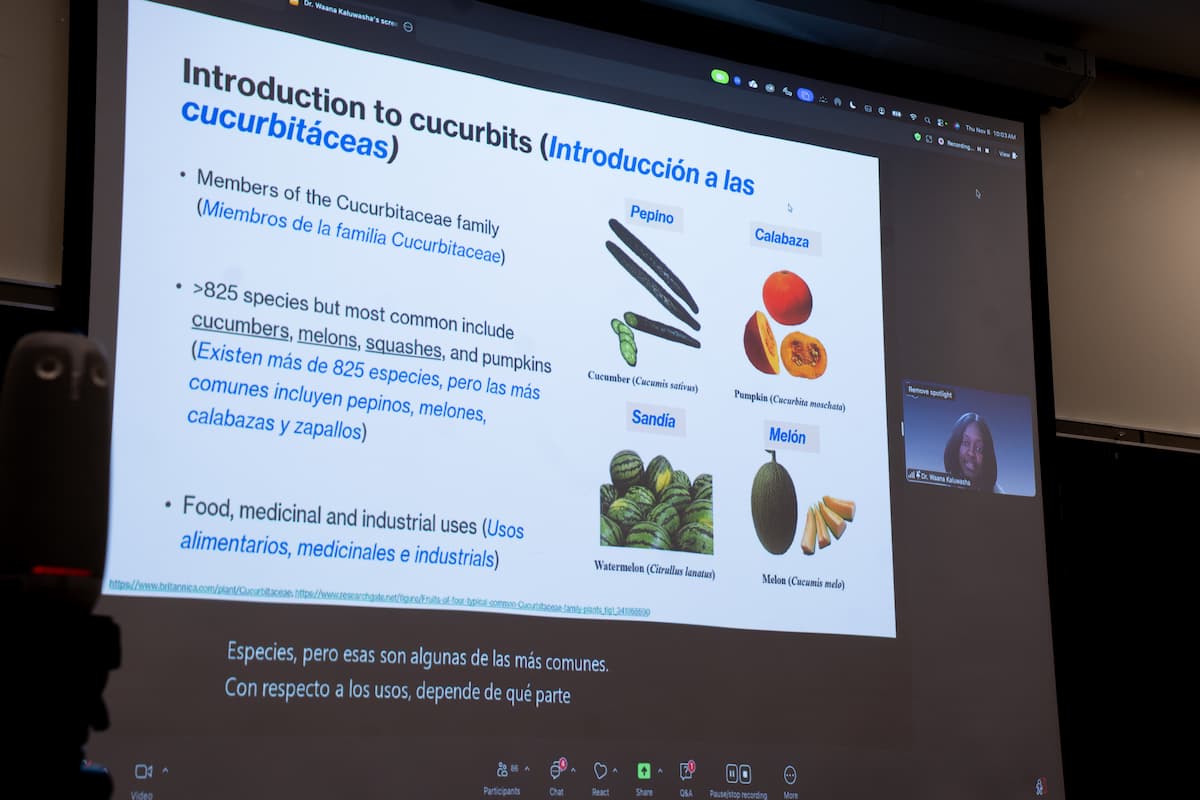 Dr. Waana Kaluwasha presenting on prevalent cucurbit diseases.
Dr. Homero Salinas, an LU coordinator and longtime collaborator, said the event’s value lies in its ability to connect people who might not otherwise have the chance to learn from one another.
“The symposium benefited the audience very much because it allowed them to learn what Lincoln University and other partner Latino universities are doing,” he said.
Over the years, the international partnerships behind the symposium continued to grow stronger. Organizers learned that successful collaboration requires more than just shared goals — it relies on effective communication, time management and respect for cultural and linguistic differences. Many partners outside the United States do not speak English, so establishing clear communication channels has become an important part of every project.
Beyond individual topics, the symposium emphasized the interconnected nature of plant and animal health. Diseases in crops and livestock lead to ripple effects that threaten food supply chains and economic stability. By sharing research and management strategies, participating universities and agricultural agencies can better equip producers and educators to respond to outbreaks more quickly and effectively.
Supported by grant funding, the “Monitoring Emergent Plant and Animal Diseases” symposium series continues to bring together universities, farmers and researchers to address common challenges in agriculture. Each session builds upon the last, expanding the network of professionals committed to strengthening food security throughout the Americas.
The event also reinforces LU’s broader mission as a land-grant university: extending education, research and outreach to communities near and far. With continued collaboration and communication, the symposium serves as a reminder that global food security depends on cooperation — and every shared idea helps feed a stronger, healthier world.
To find out about upcoming symposium dates, contact Jessica Epple-Farmer at EppleJ@lincolnu.edu or Homero Salinas at Salinas-GonzalezH@lincolnu.edu