
Training Prepares Educators to Support Organic Agriculture
Office of Communications and Marketing
Young Hall
820 Chestnut Street
Jefferson City, MO 65101
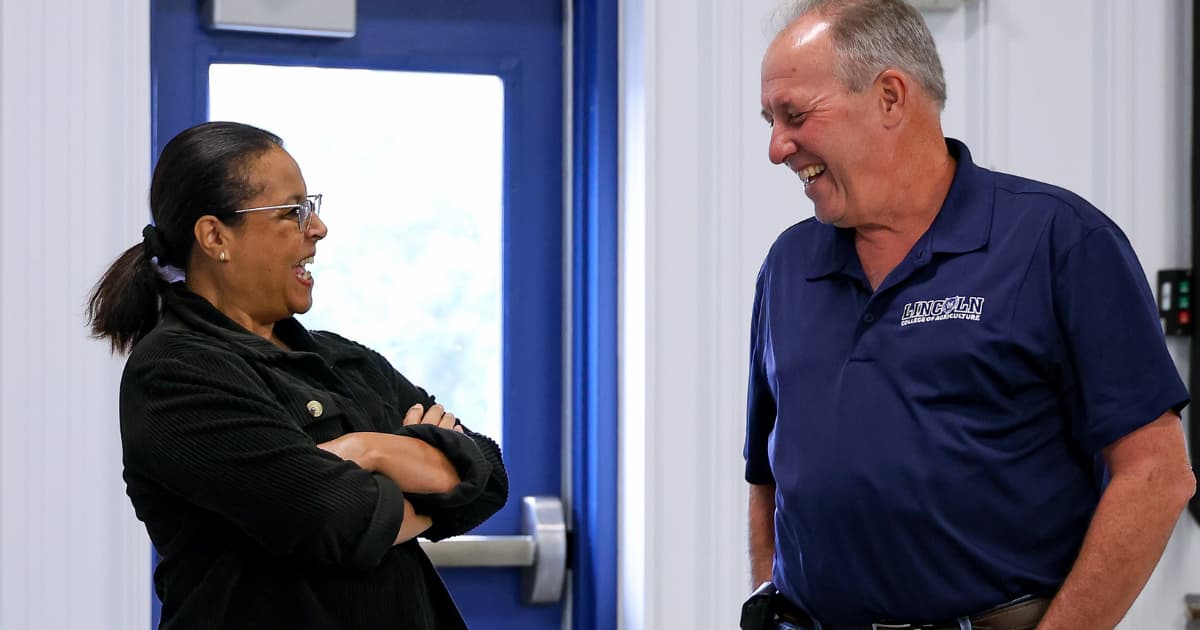 Associate Professor of Horticulture Touria Eaton, Ph.D., speaking with Farm Superintendent Chris Boeckmann before an organic agriculture training.
Lincoln University of Missouri (LU) agricultural educators, farmers and ranchers strengthened their knowledge of organic and regenerative agriculture during an in-service education training in early October at Alan T. Busby Farm, the university’s fully certified organic research farm.
Touria Eaton, associate professor of horticulture, and Sophie Whyte, area horticulture educator, led the daylong program. Whyte developed the seminar after conversations with farmers showed strong interest in organic and regenerative agriculture across Missouri. As more producers consider these approaches, they need a clear understanding of production requirements, certification and available resources. Discussions throughout the day covered common misconceptions about the term “organic,” requirements for organic labeling and pest management strategies.
“Organic foods go through certification processes, so customers know exactly what they are eating,” Eaton said. “Organic does not mean that the crops are grown without fertilizers and pesticides.”
Eaton explained organic production may involve fertilizers and pesticides approved under U.S. Department of Agriculture standards. Approved products generally contain naturally occurring plant, animal or mineral materials, although certain synthetic substances may also qualify. A complete list of substances permitted and prohibited in organic production is available online.
A discussion on pesticides addressed a common misconception surrounding organic production. An organic label does not necessarily mean a product is natural or free from potential health risks. Even with organic pesticides, growers need to follow product labels, use protective equipment and apply each product responsibly.
“It is important for growers to understand the safety risks that come with using any sort of pesticide product, whether it is organic or not,” Whyte said.
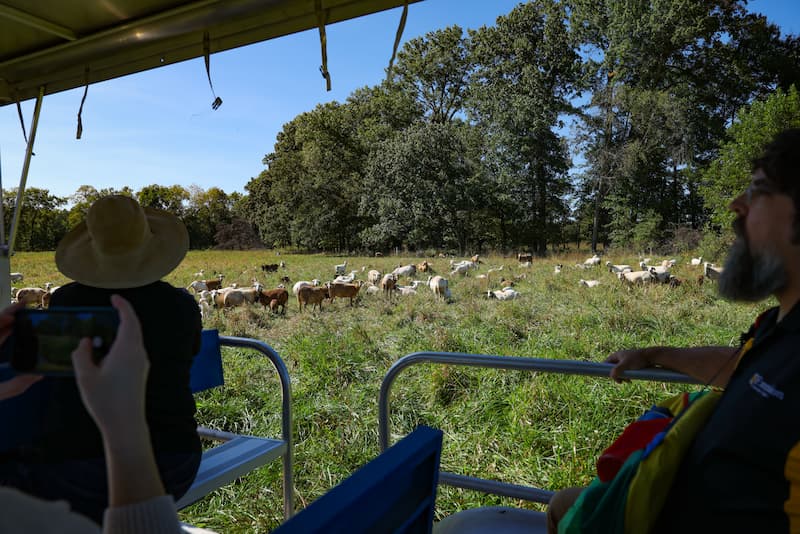 Organic agriculture training attendees view the sheep on Busby Farm during a farm tour.
Organic standards place additional restrictions on pest-management practices, often requiring growers to combine several approaches. For example, crop rotation and properly diluted copper sulfate can help reduce crop-damaging fungi. Attendees learned how cultural, physical and chemical strategies can work together within an organic production system.
Beyond pest control, participants explored the broader organic certification process, including production records, approved materials and compliance with organic standards. They also received tools and resources to support organic production and certification efforts, then toured Busby Farm to see organic practices in action.
Additionally, the program encouraged participants to learn from one another. Between presentations and during the farm tour, attendees discussed their work, formed professional connections and explored ways to strengthen agricultural outreach across Missouri.
“My favorite part of these events is the opportunity to connect with other agricultural Extension professionals and learn about the work they do to serve our communities,” Whyte said.
Through shared learning and new connections, the training gave farmers, community members and agricultural professionals information they can use and share with others interested in organic agriculture. Participants can carry those lessons into their communities, helping others better understand production practices, pest management strategies and organic certification requirements.