
Missouri Producers Explore Practical Resources at Regional Conferences
Office of Communications and Marketing
Young Hall
820 Chestnut Street
Jefferson City, MO 65101
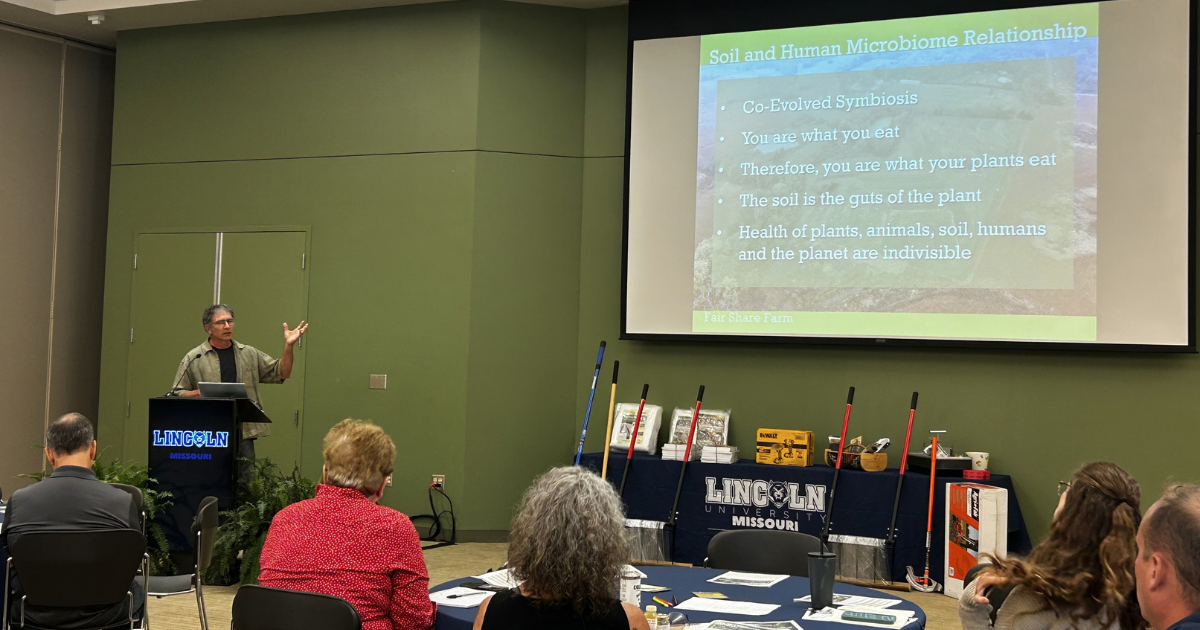 Tom Ruggieri, co-owner of Fair Share Farm in Clay County, leads discussion on the connection between soil health and the human microbiome at the Southwest Farmers and Producers Conference.
Lincoln University of Missouri’s (LU) Horticulture Program brought practical, research-based education to farmers through a recent series of regional conferences. The Southwest Farmers and Producers Conference on Aug. 27 in Springfield served as part of the series, offering agricultural education to Missouri producers closer to home. This year’s conferences share a focus on regenerative horticulture and soil health.
Area Educator of Horticulture Bleu Moore and Associate Professor of Horticulture Touria Eaton led the conference. During the day, attendees explored ways to manage soil fertility, improve soil health, cultivate medicinal herbs and support farm profitability through regenerative practices. The event also gave producers opportunities to meet one another and connect with educational resources.
“It was rewarding to watch relationships develop and to see farmers learning from and sharing experiences with one another,” Moore said. “The spirit of the conference was really bringing farmers together to learn from one another and build a stronger agricultural community in southwest Missouri.”
The event drew 35 attendees, including Jack “JJ” Spurlin, an Extension agent with LU’s Innovative Small Farmers’ Outreach Program (ISFOP) in Southwest Missouri. He said discussions throughout the day gave him ideas for his own work with growers.
“I appreciated the emphasis on farmer-led research and the idea that producers can identify real problems on their farms, test practical solutions and then share what they learn with others,” Spurlin said. “That got me thinking about ways we can create more on-farm research and demonstration opportunities here in Southwest Missouri.”
Spurlin also reflected on how Extension professionals can work alongside producers and connect them with resources suited to their specific questions.
“It reinforced for me that the challenges farmers face are not always strictly technical. Time, access to resources, risk and even having the confidence to try something new can all be barriers,” Spurlin said.
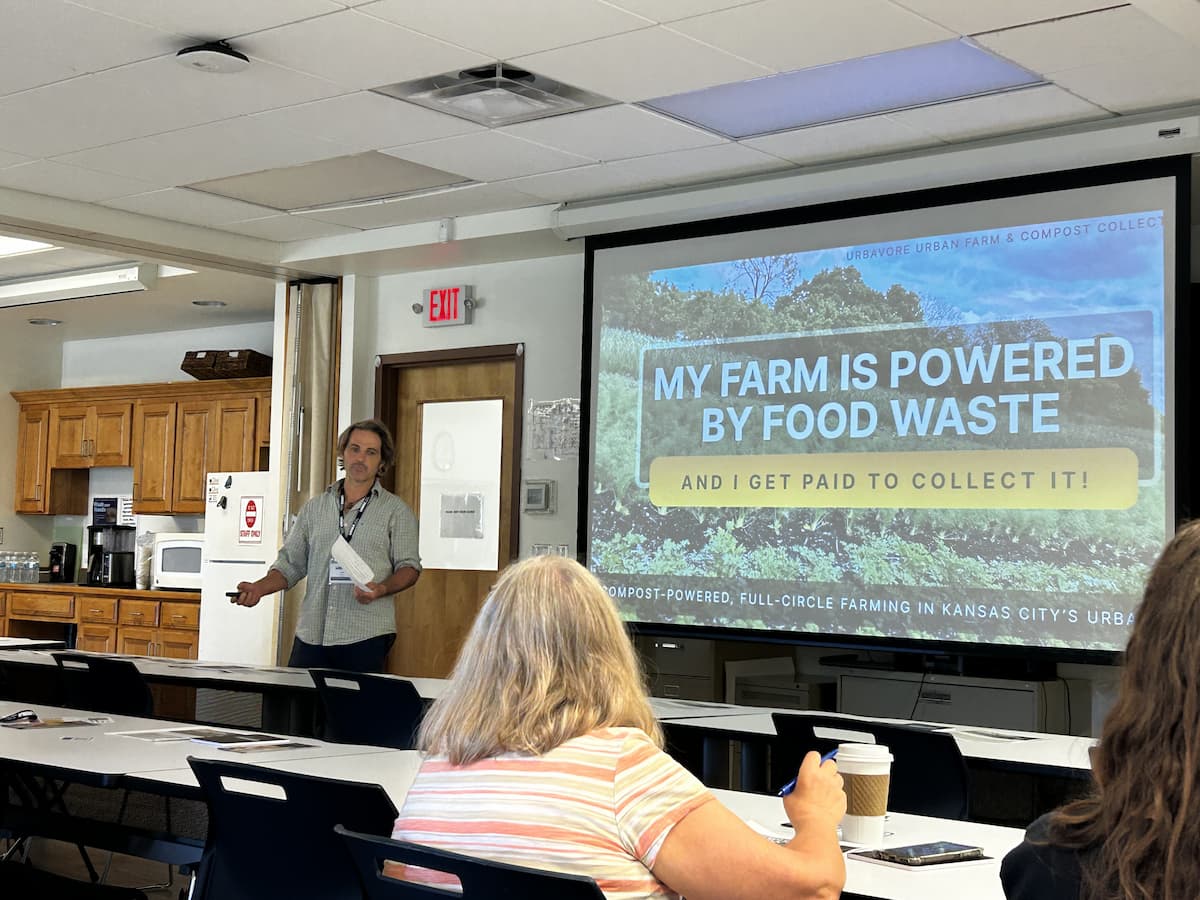 Dan Heryer, owner of Urbavore Urban Farm in Kansas City, discusses the regenerative farming practices they use to build healthier soil during a session at the West Central Farmers and Producers Conference.
The series continued Sept. 17 in Kansas City, where 25 people attended the West Central Farmers and Producers Conference. Organized by Nathan St. Clair, horticultural area educator, the event focused on the challenges producers face when growing crops amid unpredictable weather.
“Summer heat and humidity, along with periods of too much or too little rain, can affect plant health, yields, and ultimately, a farm’s profitability,” St. Clair said.
At the West Central conference, sessions gave producers several ways to explore soil health, from using compost, biochar and other organic amendments to learning about the soil microbiome. Presenters also covered vermicomposting and its benefits, along with composting and no-till vegetable and flower production. St. Clair led a session on the Horticulture Program’s mission, goals and resources for farmers in Missouri.
“Lincoln University has educators, researchers and professors who want to see Missouri farms succeed,” St. Clair said. “This conference was an example of the knowledge, connections and practical support available to producers in our area.”
Through this series, LU is bringing research-based education to producers in their own communities. Sessions cover a range of topics, including soil health and composting options, offering ideas farmers can consider for their operations, while conversations with educators and fellow producers provide opportunities to discuss local challenges.
For information about upcoming horticulture conferences and workshops, contact Touria Eaton at EatonT@lincolnu.edu.