
From The Ground Up Project Connects Research and Farmers
Office of Communications and Marketing
Young Hall
820 Chestnut Street
Jefferson City, MO 65101
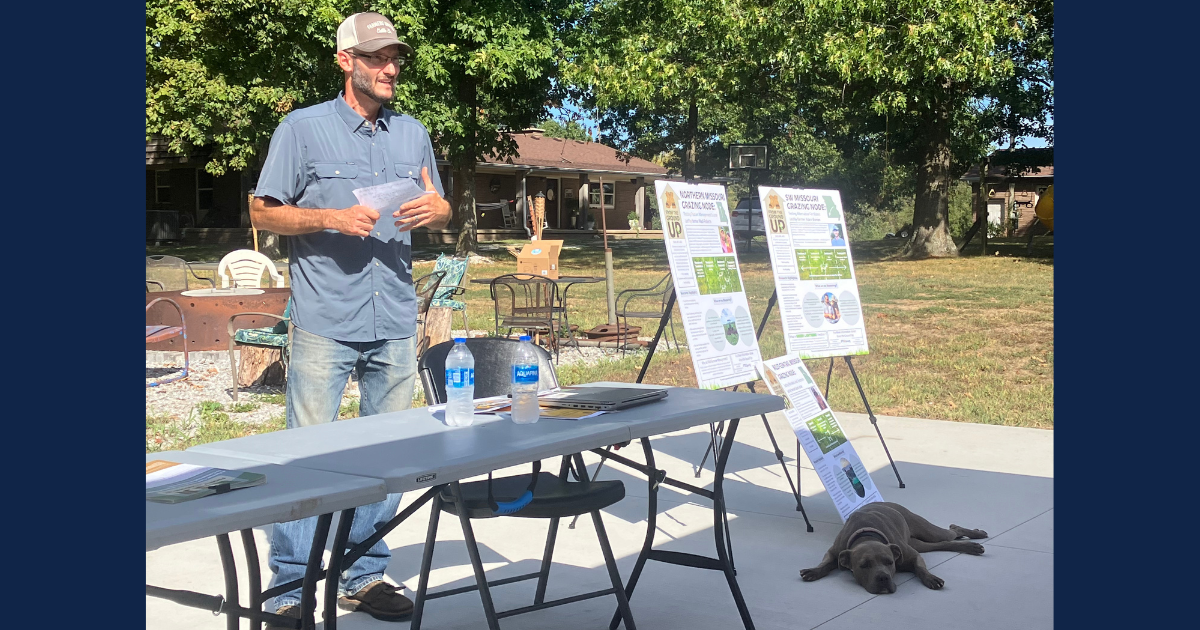 Research results from Good Life Grass Farms are presented to farmers by owner Adam Boman.
Through the project From the Ground Up, Lincoln University of Missouri (LU) researchers are helping Midwest farmers explore agricultural practices aimed at improving soil health, supporting livestock production and strengthening farm sustainability. A team of five researchers collaborate with producers to evaluate climate-smart agricultural practices under real-world farming conditions.
Mohan Acharya, state Extension specialist in LU's Small Ruminant Program, is one of the researchers involved in the multi-institution project funded by the Agriculture and Food Research Initiative, a grant program under the U.S. Department of Agriculture. Led by Douglas Jackson-Smith at Ohio State University, From the Ground Up also includes the University of Missouri, Central State University and the non-profit organization Solutions from the Land. The goal of the project is to help farmers improve their land, from promoting healthier soil to supporting more productive pastures.
“Research shows that climate-smart practices can improve soil health, store carbon in the soil, and lower greenhouse gas emissions,” Acharya said. “But still, few farmers adopt such practices.”
The initiative addresses a common challenge in agricultural research: results from university test plots do not always reflect conditions on working farms. By partnering directly with producers, researchers can evaluate climate-smart practices under everyday farming conditions.
“The on-farm research is organized into nodes,” Acharya said. “Each node is a group of six-to-eight farmers from an area of about three counties who work with scientists to run field trials.”
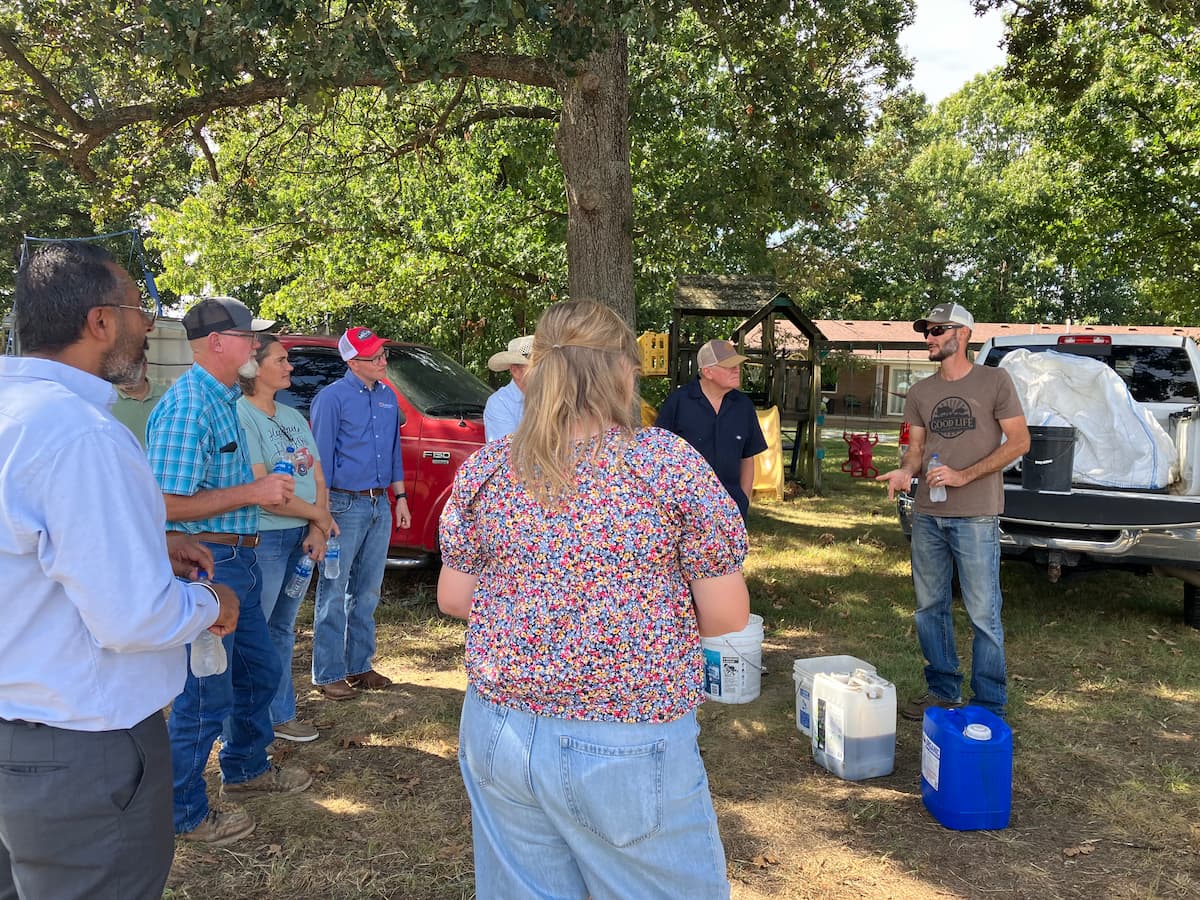 Adam Boman, owner of Good Life Grass Farms, part of the Southwest Missouri Grazing Node, explains four soil treatments he is testing and how each may affect soil health, pasture yield and forage quality.
The project includes five research nodes in Ohio and five in Missouri. In the Southwest Missouri Grazing Node, ranchers are testing four soil treatments on established pastures.
The treatments include an untreated control area, worm castings, urea fertilizer and Texas Pasture Plus fertilizer. Researchers compare the treatments to determine their effects on soil health, pasture yield and forage quality.
In addition to the pasture trials, one node in each state focuses on the effects of grazing livestock on cover crops and crop residue remaining after harvest. Researchers measure daily livestock weight gain and animal health alongside soil conditions, cover crop performance and economic outcomes. The findings help evaluate how climate-smart practices affect agricultural productivity and farm profitability.
Through LU's Extension involvement, the project also connects research findings with practical agricultural applications. Local agricultural advisors and landowners can use the results to help farmers make informed decisions about adopting new practices. National organizations can also apply the findings to agricultural programs and markets designed to encourage sustainable farming.
Beyond its work with producers, From the Ground Up creates educational opportunities for students interested in agriculture and related scientific fields through the Undergraduate Integrated Internship Program, hosted by Lincoln University and Central State University, a fellow 1890 land-grant institution in Ohio.
“Twelve interns a year, over four years, get paid summer research experience in the project,” Acharya said. “Interns then design hands-on agriculture lessons for high school classrooms with many minority students.”
Through these lessons, the program introduces younger students to agricultural research while encouraging interest in science, technology, engineering and mathematics.
For LU, participation in From the Ground Up strengthens connections between agricultural research, Extension education and the communities the university serves. By collaborating with farmers and fellow institutions, LU helps turn research into practical information for producers while supporting educational opportunities for future agricultural professionals.