
Lincoln University Supports Sheep and Goat Producers Through Education and Training
Office of Communications and Marketing
Young Hall
820 Chestnut Street
Jefferson City, MO 65101
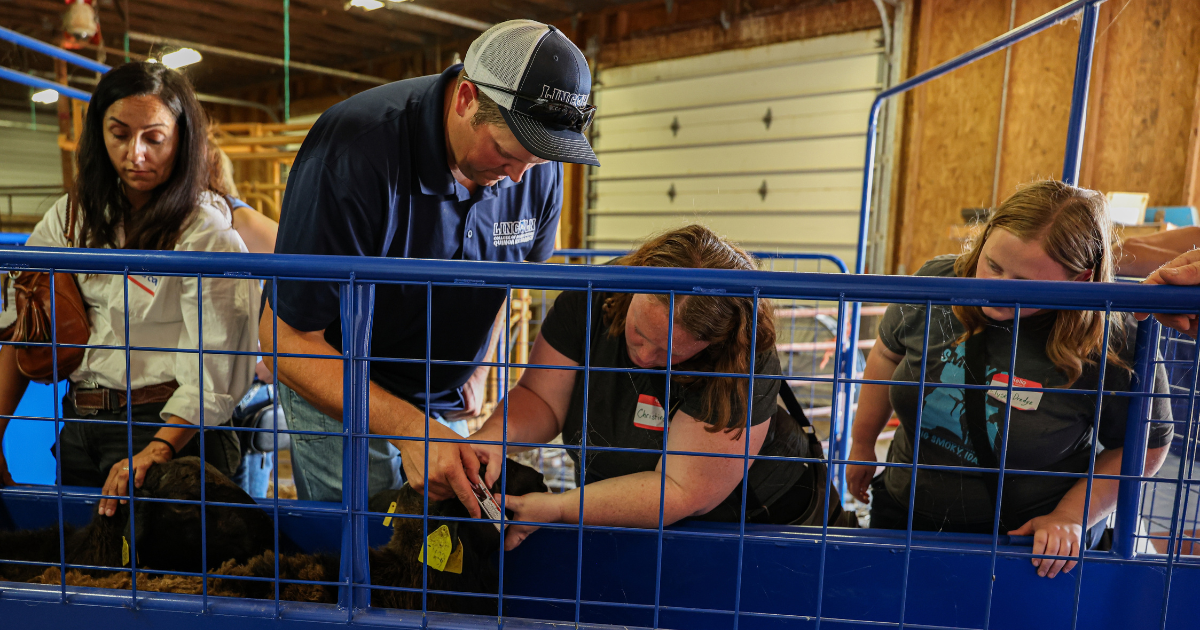 Farm manager Eric Groose helps attendees during FAMACHA® training at LU’s Small Ruminant Field Day.
Lincoln University of Missouri’s (LU) Small Ruminant Field Day brought together 68 participants at George Washington Carver Farm in Jefferson City, from newcomers to experienced sheep and goat producers, to exchange ideas, gain practical knowledge and explore ways to improve their operations.
Sponsored by LU and the North Central Region Sustainable Agriculture Research and Education (NC SARE) program, the event featured educational presentations and hands-on training designed to help producers apply what they learned to their own farms.
For Kurtis Griess, that learning comes as his own operation continues to grow. Four years ago, he and his family moved from Albuquerque, New Mexico, to Green Ridge, Missouri, in search of a place where they could grow their own food and establish a small homestead. Today, the family raises about 25 sheep, four goats and two heifers.
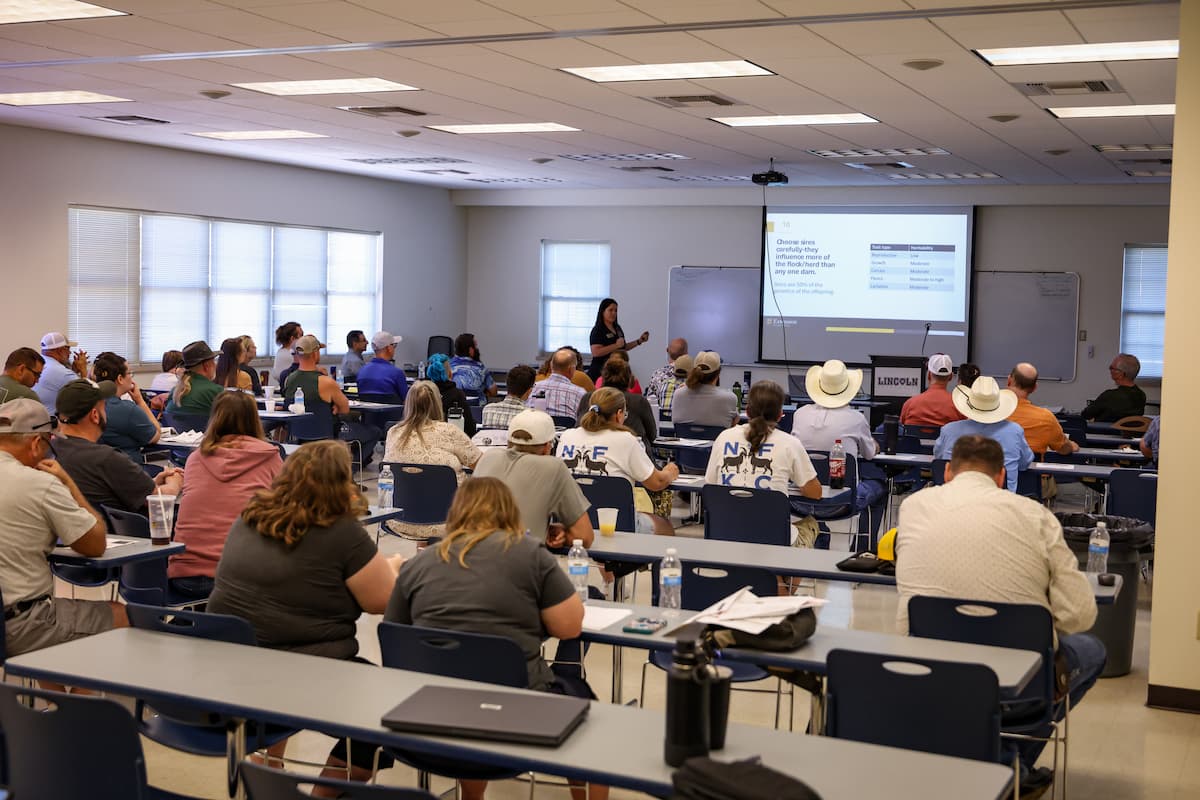 Participants listen to a presentation by MU’s Jennifer Lutes on farm economics, including how management decisions, costs and market opportunities affect profitability.
Although relatively new to raising livestock, Griess has developed a strong interest in regenerative agriculture and improving soil quality alongside animal health. Presentations by Mark Green and Mark Kennedy closely reflected those interests.
Green, of Custom Pasture Planning and Consulting in Fair Grove, Missouri, explored how grazing practices influence soil health. His presentation emphasized grazing height, recovery periods and pasture diversity, explaining their importance for plant regrowth and root development.
Multi-species grazing offered another approach to making better use of pasture. Kennedy, of Kennedy Grassland Services, LLC, in Reeds Spring, Missouri, explained that cattle, sheep and goats prefer different vegetation, allowing producers to use available forage more fully while helping manage brush and unwanted plants.
“It’s affirming to hear that their experience kind of aligns with what I’ve witnessed in my own practices,” Griess said.
He particularly valued the opportunity to learn from presenters whose technical expertise came with practical, firsthand experience.
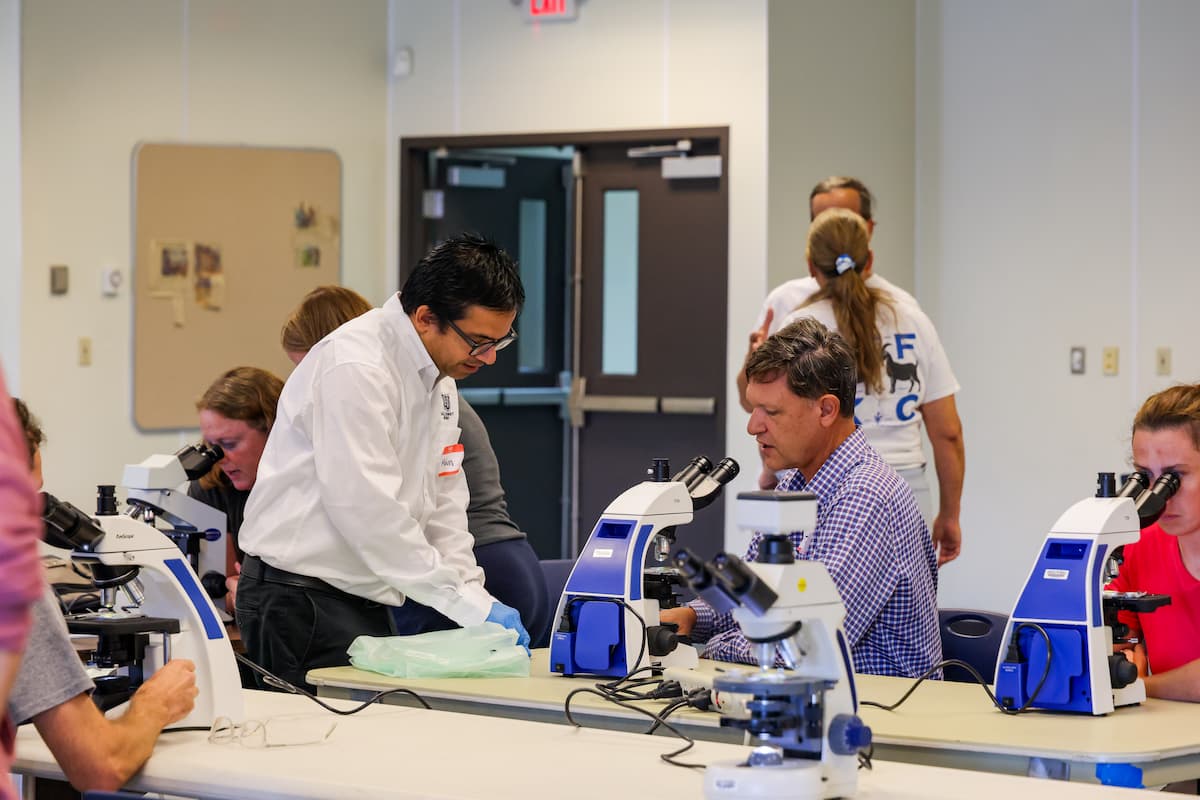 Mohan Acharya assists participants during a hands-on microscope activity focused on parasite management.
David Noble shared Griess’ appreciation for hearing from presenters whose technical expertise was grounded in practical, firsthand experience. He attended with his wife, Joanne, and together they operate Noble Farms Kansas City in Kearney, Missouri. Their operation continues a family livestock tradition dating to 1956, beginning with hogs, shifting to cattle and eventually expanding into small ruminants. The couple now raises Nigerian dwarf dairy goats, as well as Spanish-cross and Kiko goats for the meat market.
Although Noble brought considerable experience in animal nutrition, he welcomed additional insights that could benefit their goat operation.
“They’ll come up with little tidbits that are just gold for our program,” he said.
Sheep and goat nutrition was the focus of a presentation by Patrick Davis, a field specialist in livestock with the University of Missouri (MU) Extension. Davis addressed forage testing, nutrient requirements, body condition scoring and ration balancing. He encouraged producers to assess their animals' nutritional needs, examine the value of available feed and make adjustments when animal performance indicates the ration needs improvement.
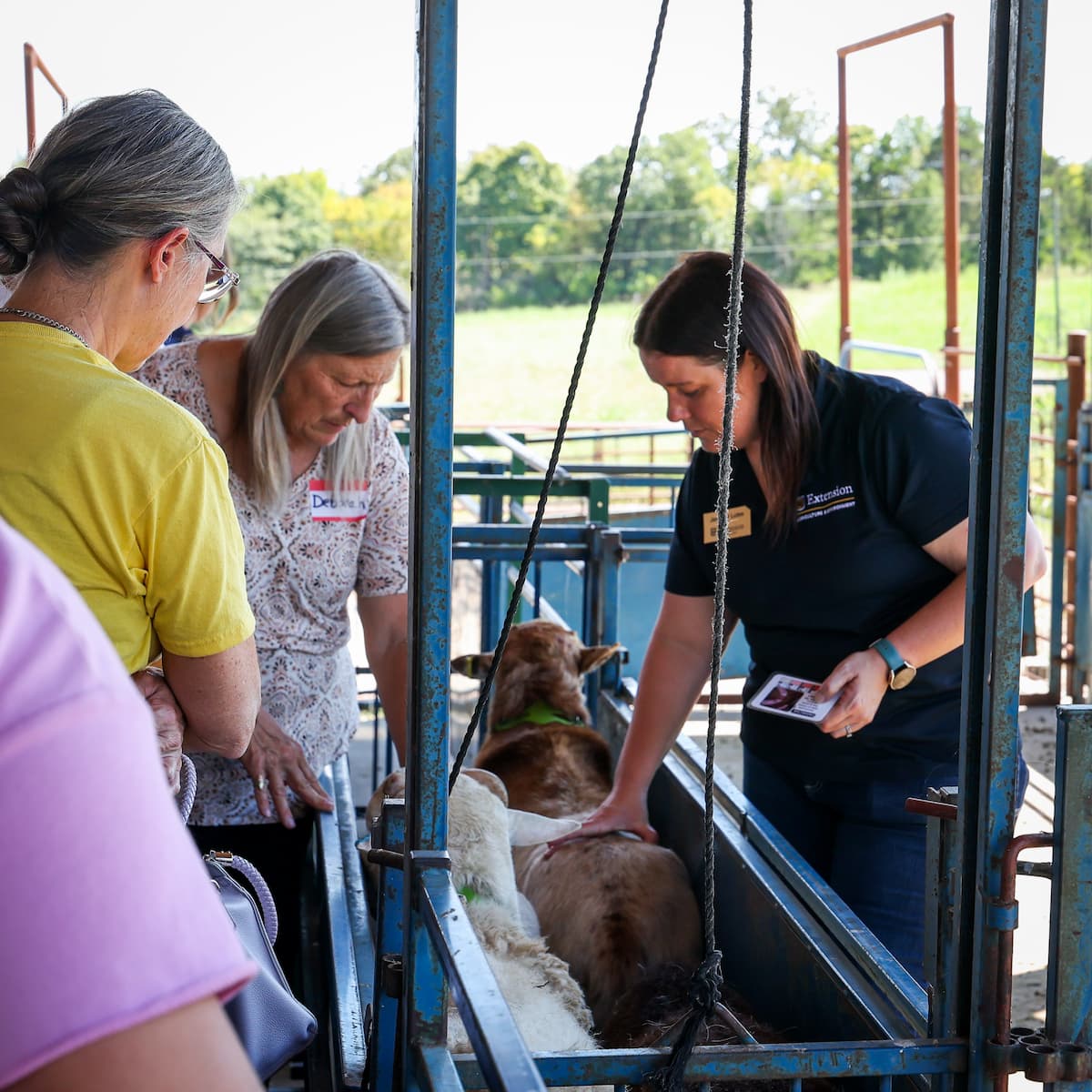 Jennifer Lutes works with participants as they practice body condition scoring during LU’s Small Ruminant Field Day.
Farm economics also caught Noble’s attention. Jennifer Lutes, a field specialist in agricultural business with MU Extension, examined the relationship between management decisions and profitability. Rather than focusing exclusively on maximizing production, she encouraged participants to consider costs, available resources and market opportunities alongside their production goals.
“I’m a business-minded person, so I connect with what she says,” Noble said. “It’s really helping to give us new avenues to explore.”
A Lunch & Learn session gave participants an opportunity to enjoy a meal catered by Sweet Smoke BBQ and explore LU’s use of virtual fencing technology. Farm manager Eric Groose explained how GPS-enabled collars and digital boundaries help producers control livestock movement and manage grazing areas without relying entirely on physical fences.
The afternoon shifted to hands-on parasite management training, an area of particular interest to Griess and the Nobles. The Nobles attended largely for FAMACHA training, which helps producers identify animals that may need treatment, reducing unnecessary dewormer use and helping slow parasite resistance.
Mohan Acharya, Ph.D., a state Extension specialist with LU’s Small Ruminant Program, demonstrated how fecal testing can support more targeted parasite management. Participants examined samples under a microscope and counted parasite eggs to assess infection levels.
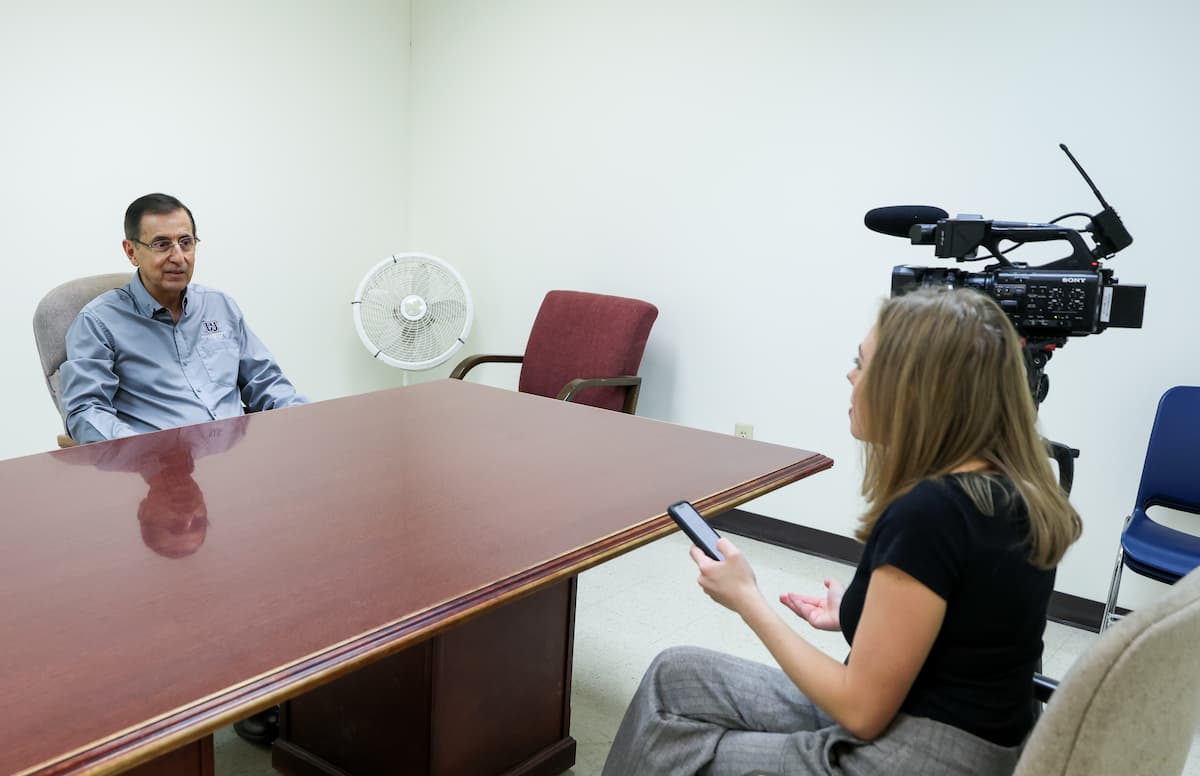 KRCG-TV interviews Homero Salinas about LU’s Small Ruminant Field Day and the resources available to sheep and goat producers.
Participants then worked with Homero Salinas, Ph.D., a state Extension specialist who leads LU’s Agriculture and Natural Resources Program, to learn the FAMACHA method. Salinas showed them how to examine a small ruminant’s lower eyelid for signs of anemia based on its color. Identifying goats and sheep that may need treatment allows producers to avoid routinely deworming an entire flock, helping slow the development of resistance to deworming medications.
At the end of the training, participants received FAMACHA certificates.
LU plans to hold its next Small Ruminant Field Day on October 23 at George Washington Carver Farm. The upcoming event will focus on meat processing, with presentations addressing state and federal regulations, lamb and goat carcass-cutting demonstrations, and discussions about pricing and marketing meat for local sales.
For more information about the upcoming field day or LU’s Small Ruminant Program, contact Homero Salinas, Ph.D., at salinas-gonzalezh@lincolnu.edu.
Photos by Alex Gordon.