
Ukrainian Veterans Explore Aquaculture Opportunities at Lincoln University
Office of Communications and Marketing
Young Hall
820 Chestnut Street
Jefferson City, MO 65101
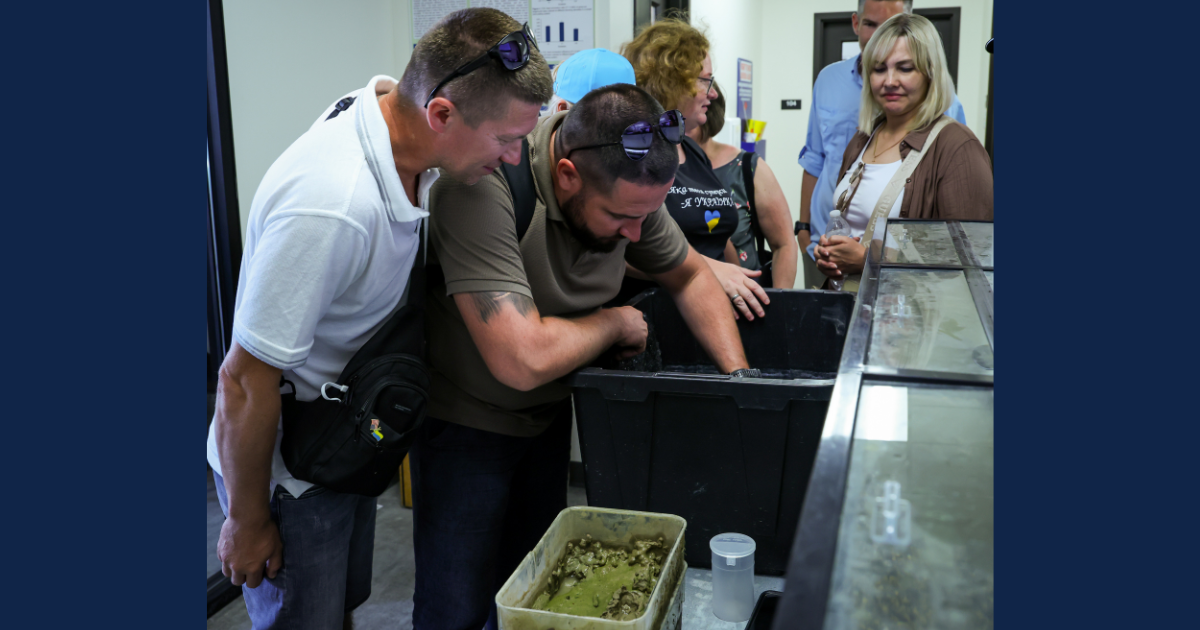 Ukrainian visitors show interest in crayfish by reaching into a tank to examine them.
About 20 Ukrainian veterans visited Lincoln University of Missouri’s (LU) George Washington Carver Farm on July 15 to learn about aquaculture production and research. The visit formed part of a broader tour organized through the University of Missouri to introduce participants to farming opportunities at colleges and universities across the Midwest.
LU’s involvement grew from a longstanding collaboration between University of Missouri faculty and LU Cooperative Extension. Through the partnership, LU representatives had an opportunity to present information to the veterans and interact with them during the tour.
The MU-Ukraine Agriculture Assistance Group connects the University of Missouri with Ukrainian agricultural educators, university campuses, Extension professionals, farmers and industry representatives. Members of the network help match Missouri-based expertise with Ukraine’s agricultural needs during the war and as the country prepares for recovery.
A Ukrainian government incentive offers citizens $50,000 to launch new agricultural operations, although existing farmers do not qualify. While land, equipment and other startup costs can quickly exceed the available funding, the program provides aspiring producers with financial support to begin exploring agricultural ventures.
As home to Missouri’s largest aquaculture research program and facilities, LU offered participants valuable insight into one potential path. The veterans learned about fish and crawfish production while exploring the steps required to establish an aquaculture operation.
At the farm’s aquaculture facility, Jim Wetzel, Ph.D., an aquaculture state specialist at LU, explained how farmers can use suitable ponds to raise fish. He discussed sourcing fish, meeting environmental requirements and selecting species appropriate for local conditions. Because the broader tour emphasized startup operations, he also encouraged participants to evaluate water access, soil composition, climate and potential profitability before investing.
“Some of my first concerns when I get people interested in doing aquaculture is making sure they have access to a good source of water,” Wetzel said. “Another is making sure they have good land.”
Wetzel said since most pond-based aquaculture operations rely on earthen ponds, which contain soil bottoms, successful production requires soil capable of retaining water. Some new farmers must amend their soil before filling a pond, adding a potentially significant startup expense.
“Sometimes it actually helps to add sand or silt that will disperse a little bit,” Wetzel said. “If you’re in an area that has lots of bedrock or there’s already lots of sand, that can be difficult to work with.”
Wetzel emphasized matching each species with an appropriate climate and production system. Farmers need organisms capable of surviving local conditions while producing enough value to support a profitable operation.
Wetzel also discussed feeding practices and recommended floating fish food pellets over sinking varieties. Floating pellets allow producers to observe feeding activity and monitor consumption more accurately. Sinking feed makes tracking intake difficult and can lead to overfeeding or underfeeding.
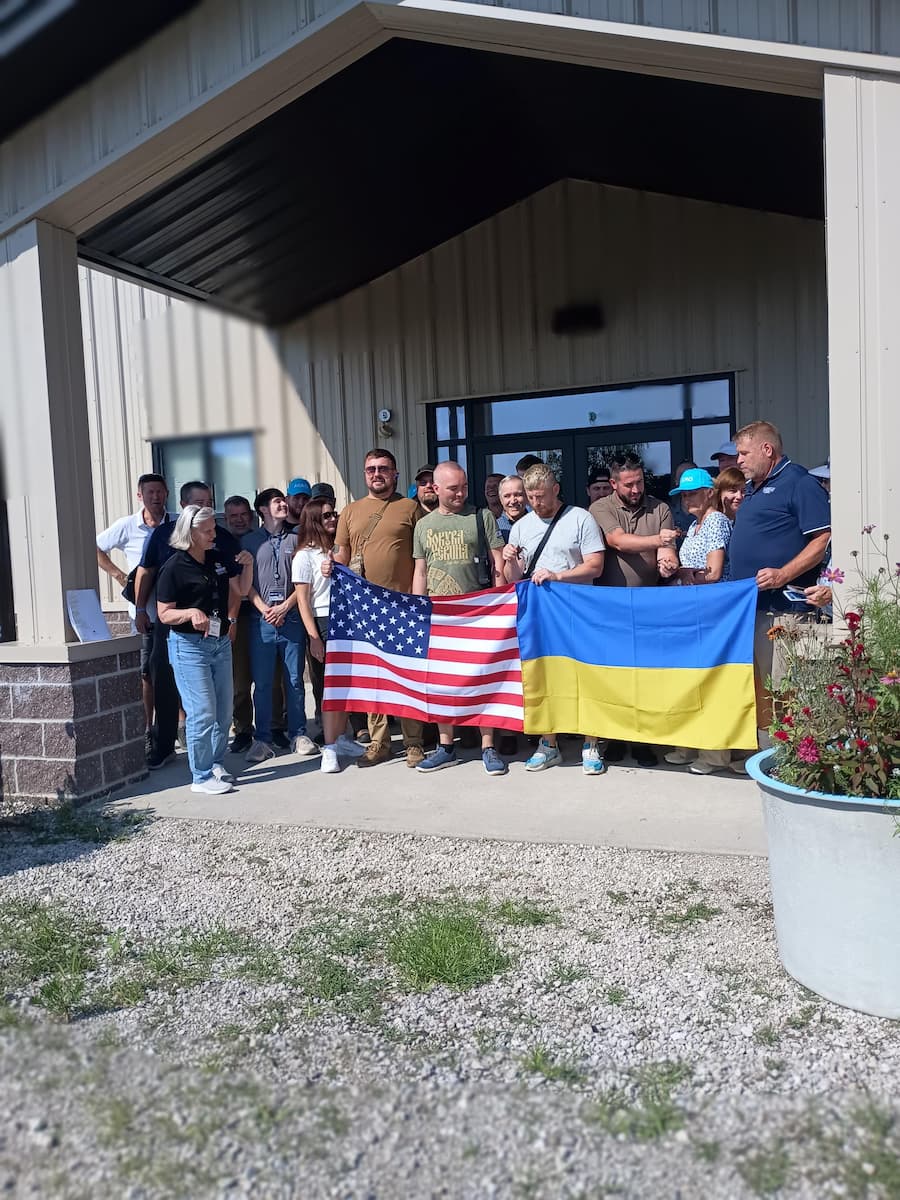 Ukrainian veterans and Lincoln University faculty and staff gather for a photo following a tour of LU’s aquaculture research facilities.
Aquaculture Manager Jacob Loesch continued the tour inside the facility’s main research area, where LU faculty and staff conduct studies in large tanks. Loesch described behavioral differences between wild fish and fish raised indoors.
“Fish that are raised indoors their whole lives will act different,” Loesch said. “They will actually swim to a hand because they think it’s food, which can be a problem in aquaculture outdoors because they will actually swim toward predators.”
Loesch explained how species selection affects production. Some species thrive in ponds or tanks containing multiple types of fish, while others perform best in single-species systems. Producers must consider feeding behavior, space, water quality and interactions among species when planning an operation.
He then introduced Moureen Matuha, assistant professor of aquaculture, who studies nutrition in rainbow trout and largemouth bass. Matuha discussed an ongoing 10-week experiment examining soybean meal as a replacement for varying percentages of fishmeal in feed.
“We’re looking at different stages of growth — the juvenile, the sub-adult and the larger sizes — to see how it effects things like growth, fertilization, digestive enzymes and blood,” Matuha said.
Soybean meal’s availability makes it a promising full or partial protein replacement in fish feed. A successful alternative could reduce producers’ reliance on costly ingredients transported from other regions.
“We want to support fish farmers,” Matuha said. “Fish prices are rising and we’re trying to see if there are other alternatives they can tap into to that can help lower production costs.”
While Matuha’s research highlighted ways to make fish production more affordable, participants also explored which aquatic species might suit future operations in Ukraine. Crayfish drew particular attention. Wetzel explained how regulations prohibit participants from purchasing LU’s crayfish and transporting them outside the United States, but native Ukrainian species could offer an alternative. He said weather extremes would not necessarily prevent participants from raising native crayfish in open ponds, although the ponds would require careful monitoring.
“With ice, the temperature isn’t the problem, it’s that there’s organic matter underwater taking up oxygen,” Wetzel said. “But if light can get through the ice, there won’t be an oxygen-level problem.”
Wetzel’s guidance addressed one of many practical questions participants raised throughout the visit. They also asked which species currently produce the greatest profits, how temperature influences fish development and how they might raise similar species in Ukraine. Their questions reflected strong interest in applying LU’s research and production guidance to future agricultural operations.
The veterans left Carver Farm with practical guidance on starting an aquaculture operation, including evaluating water sources, soil conditions, species selection, feed costs and potential profitability. LU’s research also introduced them to strategies for reducing production expenses as they explore opportunities to build agricultural operations in Ukraine.