
Lincoln University Programs Strengthen Missouri’s Workforce and Communities
Office of Communications and Marketing
Young Hall
820 Chestnut Street
Jefferson City, MO 65101
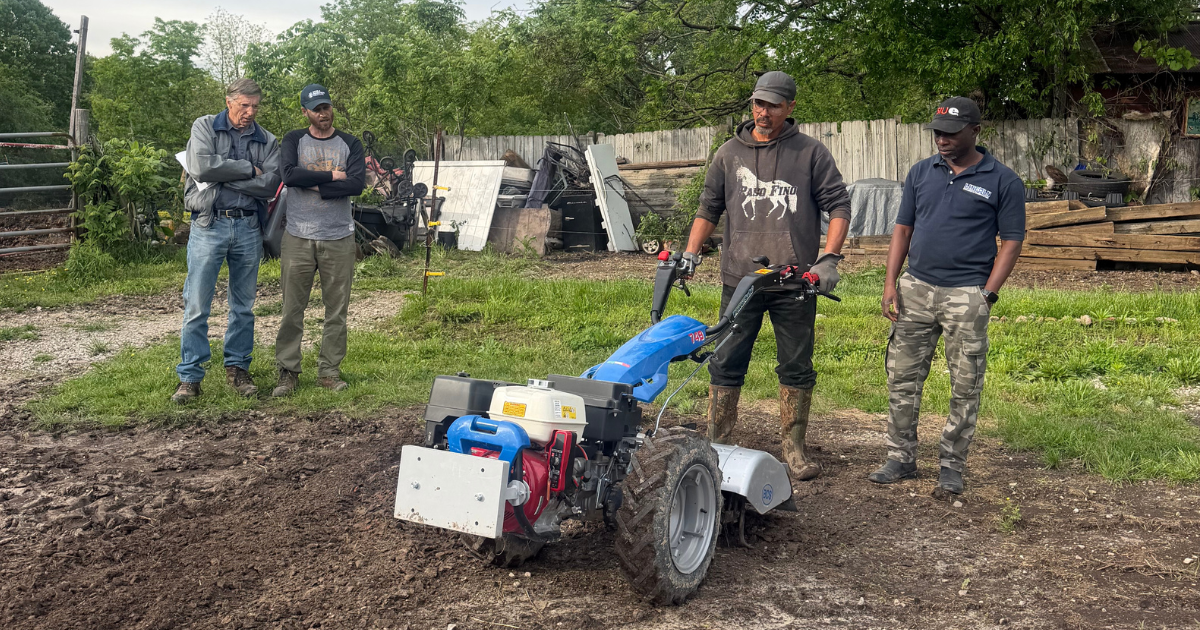 Participants of a workshop held by Lincoln University’s Agricultural Economics Program learn how to use a two-wheel walk-behind tractor.
Lincoln University of Missouri (LU) expands access to education and practical resources across the state. Through Cooperative Extension (LUCE), educators offer agricultural education, career training and professional development designed to prepare Missourians for employment, entrepreneurship and long-term economic stability while strengthening local economies.
Eleazar Gonzalez, state Extension specialist and head of the Agricultural Economics and Marketing Program at LU, works to educate producers and the public about sustainable farming, agribusiness resilience and financial decision-making during severe weather. Through workshops and field demonstrations, participants examine how sustainable practices can increase profits and help agricultural operations withstand environmental and economic challenges.
“Students attending our workshops and field-day demonstrations gain skills and knowledge that help them understand the economics and agribusiness of small farming and ranching,” Gonzalez said. “They can develop their experience through our direct on-site farming field days.”
For the past four years, the program has offered training for farmers who attend at least 80% of its agribusiness educational programming. Participants learn how to develop an agribusiness plan, establish a farm marketing outlet and make informed financial decisions. Training covers cost analysis, sales pricing, break-even points, profit percentages and agricultural risk calculations.
During the first three years, qualifying participants received certifications recognizing various levels of farming knowledge and experience. Through an apprenticeship approach, producers learned how to grow crops using sustainable production practices. Agribusiness lectures and farm visits also helped them understand business planning for small, sustainable farms.
“We reached different levels of farmers, including new beginning farmers with zero experience, farmers with some experience but not more than ten years in farming, and for experienced farmers,” Gonzalez said.
Agricultural economics develops skills applicable across industries. Creating budgets for crop or livestock production requires producers to examine supply costs, market conditions and relationships with supporting industries. Business planning builds on those lessons by combining financial projections, production budgets and operational goals.
Together, budgeting and business planning help participants understand how organizations allocate resources, manage risk and measure profitability. Students and producers can carry those skills into careers involving finance, management, marketing, logistics and entrepreneurship.
“I strongly believe there is a powerful connection among the three pillars of community economic development — agricultural economics, extension education, and small or rural communities — that can increase workforce capacity and ignite local prosperity in rural areas,” Gonzalez said.
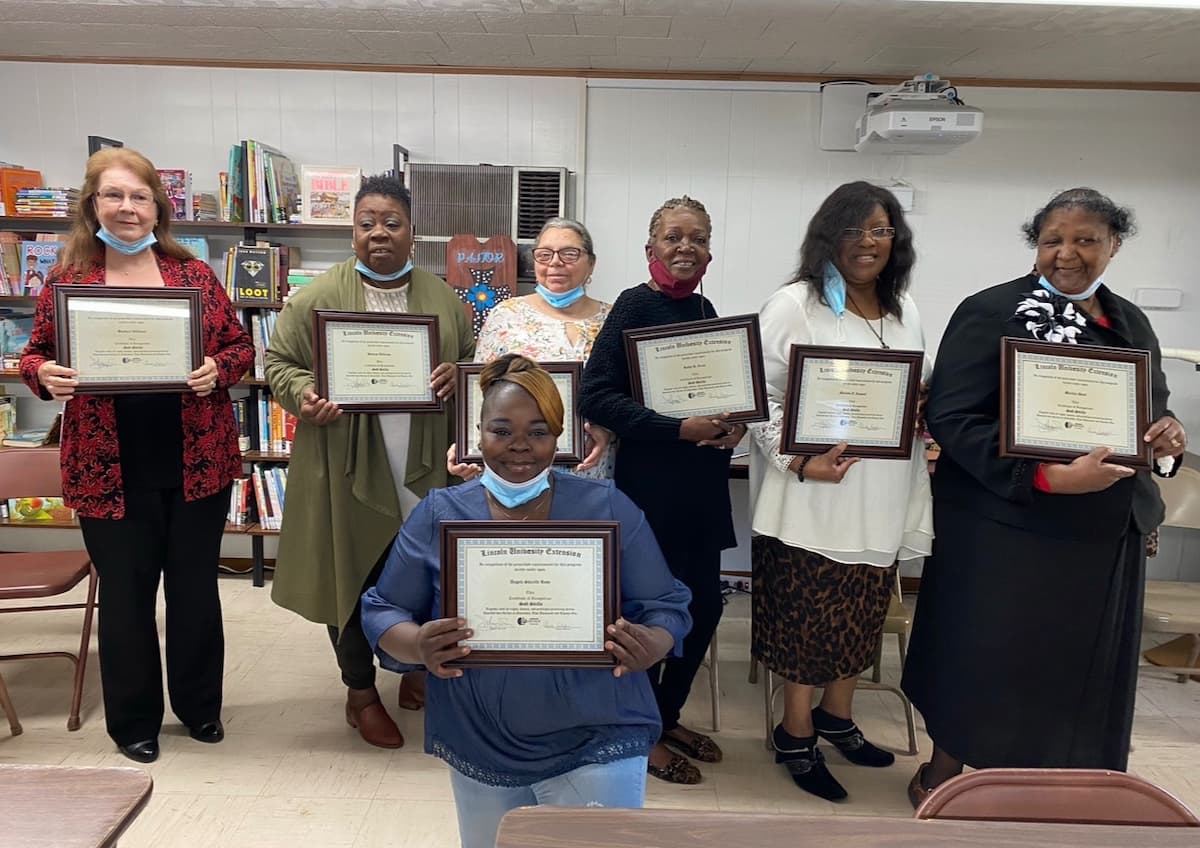 Dolores Williams with her class after completing Workforce Development training in Kennett, Missouri.
Beyond economics, LU Extension educators help community members strengthen workplace skills through hands-on learning and individualized support. Adrienne A. Hunter-Green, a family and community consumer science program educator in Caruthersville, helps participants practice clear goal setting, continuous learning and effective communication.
As a lead instructor, Hunter-Green taught a job-training course for older adults through a partnership between LU and the U.S. Department of Labor’s Senior Community Service Employment Program. Through the partnership, Hayti resident Dolores Williams connected with LU programming and later joined the university’s workforce. She continued serving LU during the COVID-19 pandemic and related shutdown.
“Ms. Williams stated that Extension made a difference in her life simply through observation and engagement,” Hunter-Green said. “She stated it taught her many things. She experienced growth, increased her ability to focus and it also forwarded her the opportunity to work with children.”
Although Williams no longer works for LUCE, she remains active in its older adult program. She participates in Lunch and Learn sessions through LUCE’s Paula J. Carter Center, continuing a relationship rooted in workforce training and community engagement. Williams’ continued involvement reflects LUCE’s commitment to supporting people throughout their professional lives.
At LU’s St. Louis Urban Impact Center, workforce education also helps adults established in their careers strengthen their skills. Regional Educator Marla Moore-Collins said the center previously trained 14 St. Louis government employees in Microsoft 365 Excel, helping them adapt to changing responsibilities and productivity expectations.
“The goal for this program was to increase employees’ professional development skills and knowledge regarding Microsoft 365 Excel due to changes in their current and future workload and expected productivity,” Moore-Collins said.
The center also supports young people through its On My Own Workforce Development Program. During the third and fourth quarters of the 2025 program year, the center partnered with St. Louis County Government and Youth on the Rise, an organization serving young people ages 16 to 19.
Approximately 11 participants pursued HiSET credentials while receiving life-skills, digital-literacy, résumé-writing and job-readiness training. They completed personal and professional interest inventories, took typing assessments and learned to create specific, measurable, attainable, relevant and timely goals through experiential activities and SMART Goal Maps. In May 2026, three of these students completed HiSET requirements and received their credentials. Program leaders also recognized other participants for a range of accomplishments.
From agricultural business planning to digital literacy and professional software training, LUCE creates pathways toward employment, advancement and entrepreneurship. Each program equips participants with practical knowledge while strengthening confidence, adaptability and connections within their communities. Through partnerships and accessible education, LU continues to expand Missouri’s workforce capacity and promote lasting local prosperity.