
LU CAEHS Research Seminar
"Acorns as Specialty Crops: Utilizing this Ancient Food"
Native Americans and other indigenous people around the world traditionally used a large variety of native edible plants in their regular diet in the past. Today, there is great interest in recovering knowledge about using these plants, such as paw paw (Asimina triloba), persimmon (Diospyros virginiana), and sochan (Rudbeckia laciniata), among many others.
These and other species are being incorporated into small farming operations, food forests, and gardens as specialty crops and to increase biodiversity. One common native group of trees with potential as a specialty crop are oaks because they produce edible acorns.
Oaks are widespread in Missouri, being dominant in woodlands, forests, and savannas, and many are used as ornamental trees. Oaks are divided into two main groups: black oaks and white oaks. Acorns are a significant source of food for mammals, birds, and insects, as well as for domestic pigs.
According to the United States Department of Agriculture, raw oak acorns are rich in fat, protein and carbohydrates and contain potassium, phosphorus, manganese, magnesium, calcium and other minerals. Oak acorns can be used to make flour or added to meals for their nutty flavors.
The demand for flour and other acorn products is growing, but the supply is limited. The price is higher than other flours due to labor-intensive harvesting and processing. White oak acorns are preferred for processing due to the lower tannin content.
The focus of this seminar is to discuss the potential of oak acorns as specialty crops, as well as preferred species, yield, and acorn processing. These and several other native edible plants can be seen growing at the Finca EcoFarm and Native Plant Outdoor Laboratory on campus, and at Busby Farm where growth data and production has been documented since 2021.
About the presenter:
Dr. Nadia Navarrete-Tindall is a Professor and Extension State Specialist who leads the Native and Specialty Crops Program at Lincoln University of Missouri. She holds a BSc in Agronomy from the Universidad de El Salvador, along with an MSc in Forestry and a PhD in Plant Biology from Southern Illinois University in Carbondale.
She oversees outreach and education projects in topics related to native plants for their benefits to people and wildlife including the Families Integrating Nature, Conservation and Agriculture (FINCA) project that provides educational tools to students, small farmers and the public to identify, grow and market native plants important for pollinators, food and conservation. At present, she is implementing the Urban AgLearning Hub with funds from a NIFA- Capacity Building Grant to coordinate training with other extension specialists on campus, non-profit organizations, other institutions, and local communities.
Along with her team, she maintains two native plant demonstration areas on campus including the Finca EcoFarm and the Native Plant Outdoor Laboratory at LU campus with more than 120 native plant species including wild plums, persimmons, paw paws, elderberries, herbs, native ferns, perennial greens and wetland species. A community garden has been created for students and local community to practice their agricultural skills. Here, non-native specialty crops like garlic, jicama, callaloo and traditional annual vegetables are grown annually.
The LU-Farmers Market on campus is under her supervision. A native fruit finca plot established at LU-Busby Farm is used for training and demonstration of productive native edible crops.
In 2008 she received the Master Conservationist award which is the highest conservation honor in Missouri and is a committee advisor for the Grow Native! Program in Missouri.
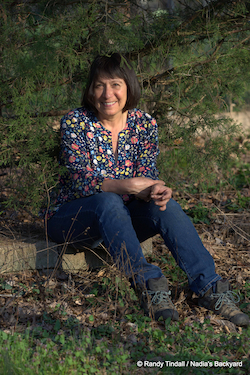
Photo of Nadia Navarrete-Tindall